

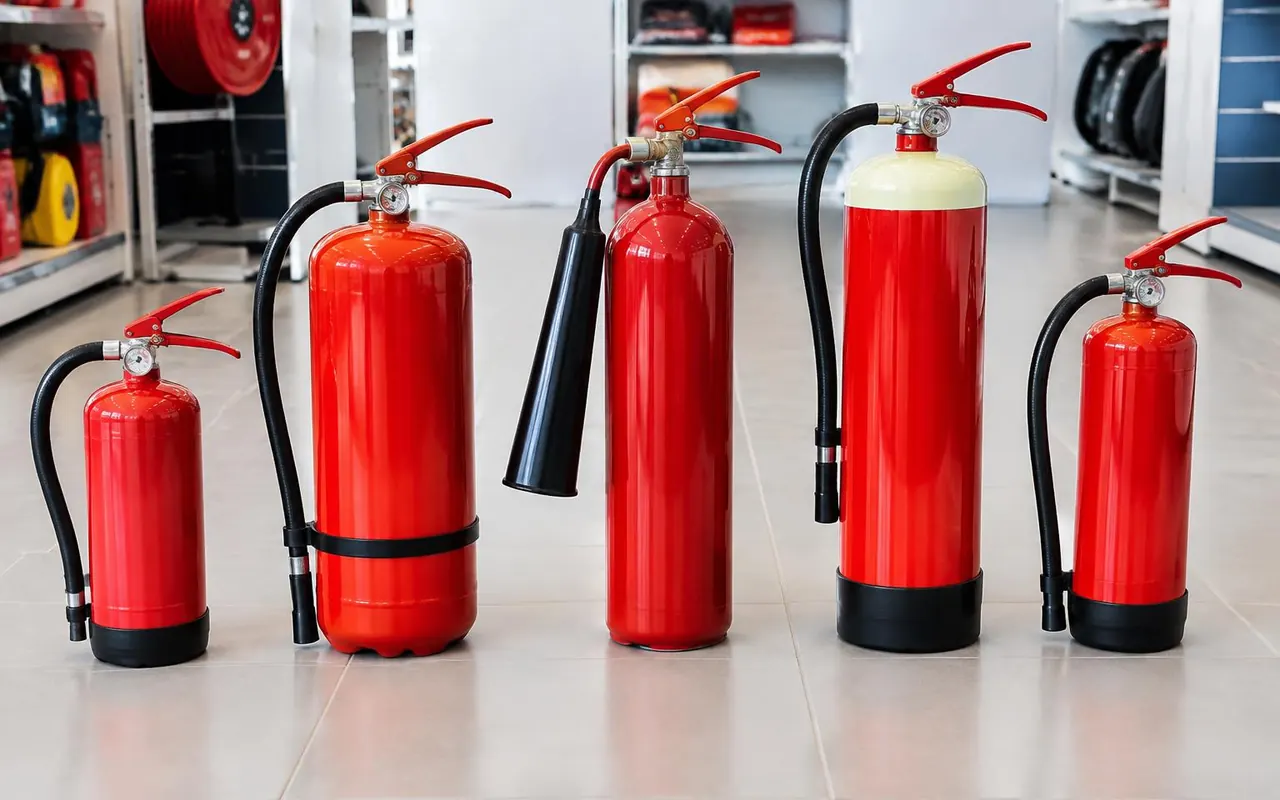
A wrong extinguisher can spread a fire or shock the user. Water on hot oil throws burning fat across a kitchen. This guide explains the types of fire extinguishers sold in India, the classes they cover and where each one belongs.
Fire classes decide the type
Fires are grouped by the fuel that burns. Kitchen oil can appear as Class F or Class K on Indian labels. Live electrical equipment has its own marking on the label.
- Class
- A
- What burns
- Wood, paper, cloth, plastics
- Types that work
- ABC powder, foam, water mist, water
- Class
- B
- What burns
- Petrol, diesel, oils, paints, solvents
- Types that work
- Foam, ABC powder, CO2, clean agent
- Class
- C
- What burns
- LPG, PNG and other gases
- Types that work
- ABC or BC powder, after shutting the gas
- Class
- D
- What burns
- Magnesium, aluminium powder, sodium
- Types that work
- Class D special powder only
- Class
- K or F
- What burns
- Cooking oil and fat
- Types that work
- K type wet chemical
- Class
- Electrical
- What burns
- Panels, servers, wiring
- Types that work
- CO2, clean agent, ABC powder
ABC powder and CO2 for everyday risks
ABC powder uses mono ammonium phosphate. It covers Class A, B and C fires, so it suits offices, shops, homes and vehicles. The powder settles everywhere and can harm electronics.
CO2 smothers a fire and leaves no residue. It suits electrical panels, server racks and labs. It does little on burning paper or wood, and the horn gets very cold.
Foam and water mist for liquids and busy buildings
Mechanical foam, often called AFFF, spreads a film over burning fuel and stops it giving off vapour. It suits fuel stores, garages and paint shops, but keep it away from live panels.
Water mist sprays de-ionised water as very fine droplets. It cools Class A fires with little water damage, so hospitals, hotels and malls use it. Use it on live equipment only if the maker's test report allows it.
K type for kitchen oil fires
A K type extinguisher holds a wet chemical solution. It cools hot oil and reacts with the fat to form a soapy layer that stops the fire coming back. Restaurants, hotels and canteens need one near every fryer. Keep a fire blanket beside it and shut the gas first.
Clean agent for electronics and records
Clean agent units use gases such as HFC-236fa or FK-5-1-12. The agent turns to vapour, leaves no residue and does not conduct electricity. Server rooms, banks and archives use these types of fire extinguishers to protect equipment and paper. For a whole room, a fixed system is the better fit, as our FM200, CO2 and inert gas guide explains.
Lithium battery fires need a different agent
A damaged lithium-ion cell can overheat in a chain reaction called thermal runaway. Powder and CO2 knock the flame down, but the cells keep heating and often reignite. Lithium battery extinguishers spray an aqueous vermiculite dispersion, known as AVD. The platelets coat the cells, cool them and form a barrier.
ISI marked AVD units are now sold in India. Fit them near EV and e-bike chargers, UPS rooms and battery banks.
Industrial and wheeled extinguishers
Factories, warehouses and tank farms often need more agent than a hand unit carries. Trolley mounted extinguishers hold 25 to 135 kg or litres of powder, foam or CO2 on wheels. Plants that machine magnesium or aluminium need Class D powder, because water reacts violently with burning metal. Automatic modular units hang from the ceiling and discharge when a heat bulb bursts.
Labels, colour and the ISI mark
In India most extinguisher bodies are red, so colour alone does not tell you the type. Read the label. It names the agent, the fire classes, the rating and the service dates. Buy units that carry the ISI mark under IS 15683.
Type guides for each city
Each type has its own page with sizes, placement, local examples and service plans.
- ABC powder in Hyderabad and Visakhapatnam
- CO2 in Hyderabad and Visakhapatnam
- Foam in Hyderabad and Visakhapatnam
- Water mist in Hyderabad and Visakhapatnam
- K type wet chemical in Hyderabad and Visakhapatnam
- Clean agent in Hyderabad and Visakhapatnam
- Lithium battery in Hyderabad and Visakhapatnam
- Industrial units in Hyderabad and Visakhapatnam
Your next step
Send us your rooms and hazards. We will mark the right types of fire extinguishers on your plan and quote supply, mounting and refills. Our offices cover fire extinguishers in Hyderabad and fire extinguishers in Visakhapatnam, with refilling and servicing in Hyderabad and in Visakhapatnam.
Standards and approvals
IS 15683 covers how portable extinguishers are built and tested. IS 2190 covers selection, installation and maintenance, so check the current revision with your fire officer. Wheeled units fall under IS 16018 and Class D powder under IS 11833.
What affects the price
- Type and capacity
- Number of units
- Brackets and signs
- Refilling and testing
What to send us
- Floor plan or sketch
- Rooms and hazards
- Existing units and refill dates