

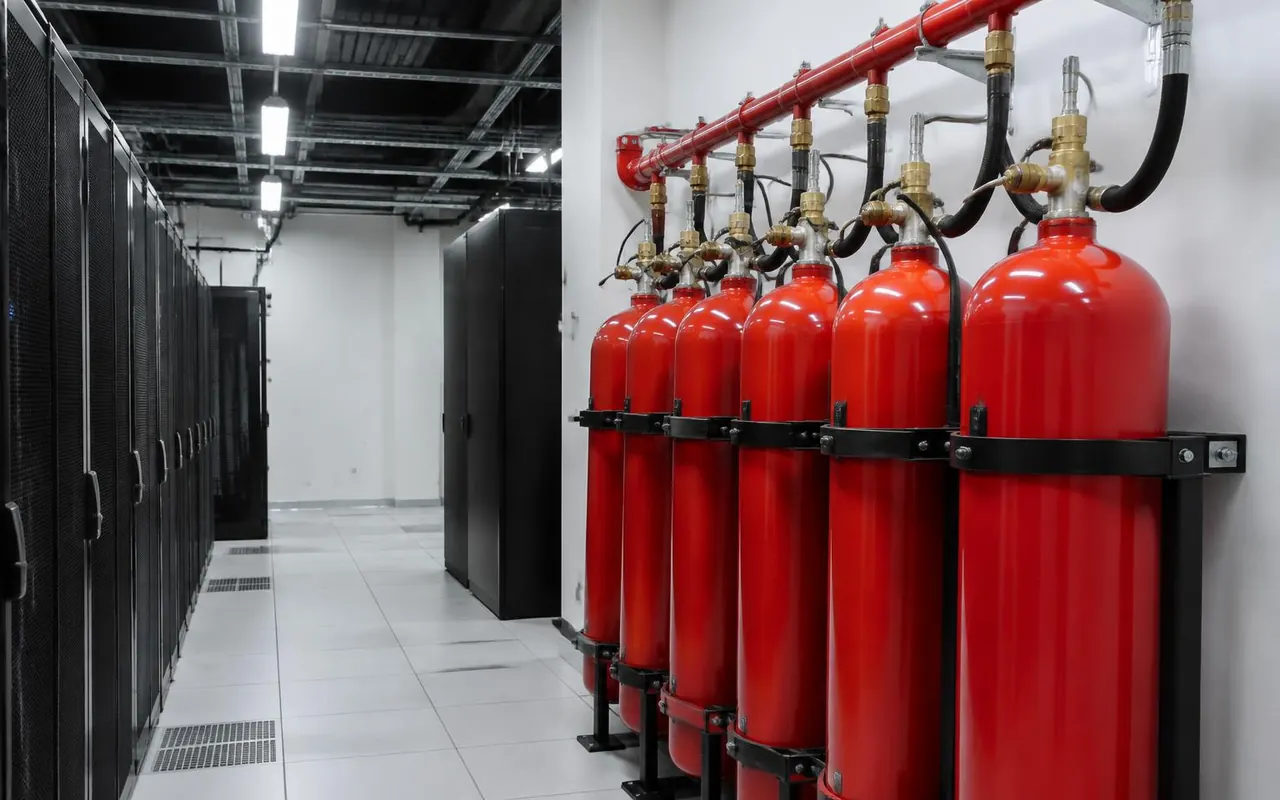
Gas suppression protects rooms where water would ruin the equipment. Choosing between FM200 vs CO2 vs inert gas suppression depends on who enters the room, what is inside and how much space you have for cylinders. This guide compares the three in plain terms.
How gas suppression works
A detection system senses smoke or heat and triggers a short delay. An alarm warns people to leave. Then the gas releases into the sealed room and puts out the fire without water. The room must be well sealed, or the gas leaks away too fast.
Read more in our pages on FM200 gas suppression and CO2 flooding.
FM200 in brief
FM200 is a clean agent, stored as a liquid in cylinders and released as a gas. It leaves no residue, and at its design concentration it is used in rooms where people may be present, with an alarm and delay. Server rooms, control rooms, archives and telecom rooms use it widely.
Environmental rules on this family of gases are tightening, so ask your supplier about the plan for refills and replacements.
CO2 in brief
CO2 puts out fires by displacing the oxygen. The concentration needed is dangerous to people, so CO2 suits unoccupied spaces such as generator rooms, paint stores and some machinery enclosures. It needs strong safety features: delay, alarm, lock-off and a clear warning at the door.
It costs less to refill than many clean agents, and it works on many industrial fires.
Inert gas in brief
Inert gas systems release a mix such as nitrogen and argon to lower the oxygen level enough to stop the fire, while people can still breathe for a short time. They leave no residue and are friendly to the environment.
The gas is stored at high pressure, so the system needs more cylinders and more space than FM200. Some sites cannot spare it.
How to choose
Start with the room: who enters, what it holds and how well it can be sealed. Then check cylinder space, refill access and budget. Our electrical panel fire suppression and water mist pages cover smaller cases and other options.
Mistakes to avoid
Buyers who compare FM200 vs CO2 vs inert gas suppression often make these mistakes.
- Using CO2 in a room where staff work, without lock-off and warning systems
- Ignoring room sealing, so that the gas leaks before the fire is out
- Forgetting where the cylinders will sit, then finding no space
- Skipping refill planning, so that a discharged system stays empty for weeks
- Choosing by price alone, without checking the agent against the contents
Your next step
Send us the room size, its contents and photos. We will compare the three gases for your room, quote the options and arrange a door-fan test. Essatech designs, supplies, installs and services these systems in Hyderabad and Visakhapatnam. Send us your drawings or photos for a priced plan.
What affects the price
- Room volume and sealing
- Agent type and cylinder count
- Detection and release panel
- Piping and nozzles
- Safety interlocks and signs
- Commissioning, door-fan test and refills
What to send us
- Room size and height
- What the room holds
- Whether people work inside
- Space for cylinders
- Drawings or photos