

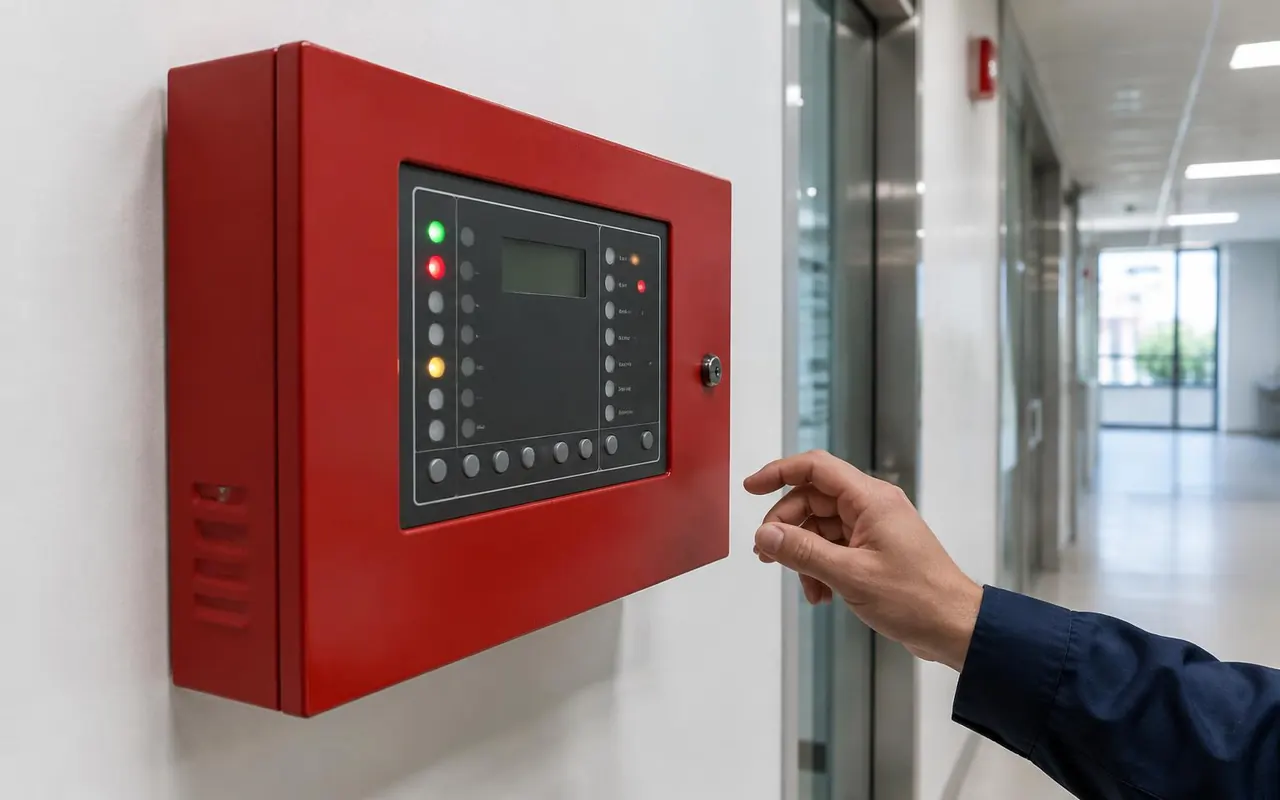
This page is part of our fire alarm systems range. Walk into the security cabin of many Hyderabad towers and you will see a panel with three or four fault lights that everyone has learnt to ignore. A fire alarm system in Hyderabad only protects people when it is planned to the building, wired cleanly and kept healthy. We handle both conventional panels and addressable systems, and we size each design from your drawings. For the approval side, our fire NOC consultant page explains how we prepare papers for the fire department.
What a fire alarm system is made of
Think of it in five pieces. Detectors on the ceiling watch for smoke or heat. Manual call points on the walls let anyone raise the alarm by pressing a red box. Hooters and flashing strobes tell people to leave.
The control panel is the brain. It reads every device, decides when there is an alarm, and shows the guard which area or detector started it. Power is the last piece, with mains supply and standby batteries that carry the system through a cut.
Wiring joins it all together. We use fire-survival cable, so hooters keep sounding even while a fire damages the building. It runs in its own conduit, separate from lighting and power circuits.
Conventional or addressable
The two panel types differ in how much they tell you. A conventional panel groups detectors into zones, so the guard knows the floor but not the room. An addressable panel knows each device by its number and shows the exact spot on screen.
Small offices, shops and single-floor units usually do well with conventional. Towers, hospitals, hotels and large factories nearly always need addressable, because finding one detector across twenty floors takes too long otherwise.
- Question
- Where is the alarm
- Conventional panel
- Zone or floor
- Addressable panel
- Exact device and room
- Question
- Typical building
- Conventional panel
- Shop, small office, single floor
- Addressable panel
- Tower, hospital, campus, large plant
- Question
- Cable layout
- Conventional panel
- Separate circuit for each zone
- Addressable panel
- Loops carrying many devices
- Question
- Finding a fault
- Conventional panel
- Check every device in the zone
- Addressable panel
- Panel names the faulty device
- Question
- Starting price
- Conventional panel
- Lower
- Addressable panel
- Higher, though cable savings help on big sites
Picking the right detector for each room
Every room gets the detector that suits its air and its fire risk. Optical smoke detectors cover most offices, corridors and bedrooms. Heat detectors go in kitchens, pantries, DG rooms and car parks, where fumes or steam would set off a smoke head.
Multi-sensor detectors read both smoke and heat, which cuts false alarms in hostels and hospital wards. Tall atriums, warehouses and factory sheds suit a beam detector that throws an infrared beam across the space. Data centres and server rooms often use aspirating detection, sometimes called VESDA type, which samples air through small pipes and catches smoke very early.
We take device numbers and spacing from the design and the drawings. Ceiling height, beams, false ceilings and air flow all change where detectors must go.
Cause-and-effect when a detector trips
An alarm should set off a planned chain of actions in the building. That plan is called the cause-and-effect matrix. We write it with your MEP consultant or facilities team and test every line of it.
In most Hyderabad towers the chain looks like this. Hooters sound on the fire floor and nearby floors, or across the whole building. Lifts return to the ground floor and open. Air handling units shut down so smoke does not spread through ducts. Access-controlled doors on escape routes release. The fire pump panel gets a signal, and the public address system can play a recorded evacuation message.
- Hooters and strobes sound in the planned areas
- Lifts come down to the ground floor and park with doors open
- AHUs and fresh-air fans switch off
- Access-controlled doors on escape routes unlock
- Fire pump panel and BMS receive the alarm
- PA system plays the evacuation message
- The nearest CCTV camera can show on the guard's screen
Faults we find on service calls
Most failing alarm systems in the city suffer from the same short list of problems. Standby batteries are the first. They last a few years, and many we test can no longer hold the panel for even an hour.
Painted-over detectors are the second. Interior work often leaves smoke heads covered in paint or dust caps, so they cannot sense smoke at all. Third, loops or zones get isolated during a false alarm and are never switched back on. The panel then shows a quiet building with a whole floor unprotected.
A yearly fire safety AMC catches each of these before an inspection or a fire does. Where cameras are linked to the panel, our fire and CCTV integration service tests both sides together.
Testing and handover
Commissioning is where we prove the system works. We run a loop test so every device answers the panel with the right address and label. We measure sounder levels in rooms and stairs so the alarm can be heard over normal noise.
Then we test the cause-and-effect line by line, with the lift, HVAC and pump teams present. You get as-built drawings, a device list, test records, panel manuals and a short training session for your guards. Those papers matter when the fire department inspects the building.
Fire alarm work across Hyderabad
Glass towers and IT campuses in Gachibowli, Hitech City, the Financial District and Kokapet make up much of our fire alarm work. These buildings run tall, with basements, food courts and data rooms, so they nearly always need addressable panels and a long cause-and-effect list.
Factories in Patancheru and Jeedimetla need heat and flame detection in production areas and beam detectors in sheds. Hospitals and apartment blocks in Kukatpally, Miyapur and Secunderabad need clear zoning and alarms that patients and residents can hear at night.
High-rise approval in the city runs through GHMC and HMDA, with fire inspection by the Telangana State Disaster Response & Fire Services Department. Our Gachibowli office handles design and installation for every fire alarm system in Hyderabad we take on, and the Hyderabad office page lists all our local services. For coastal sites, see our fire alarm system in Visakhapatnam page.
Areas we serve. Not sure we cover your area? Call the office and ask.
- Gachibowli
- Hitech City
- Financial District
- Kokapet
- Patancheru
- Jeedimetla
- Kukatpally
- Miyapur
- Secunderabad
Standards and approvals
We design to NBC 2016 Part 4 and IS 2189, the Indian code for installing automatic fire detection and alarm systems, and we use EN 54 or UL listed equipment. The fire NOC is issued only by the Telangana State Disaster Response & Fire Services Department. Essatech prepares the system and its records but does not issue or promise approval.
How the work runs
- Send drawingsShare floor plans, building height and use, and any existing panel details.
- DesignWe mark detectors, call points, hooters and cable routes, and draft the cause-and-effect list.
- QuoteYou get an itemised quote that lists the panel, devices, cable and commissioning.
- InstallationOur team lays cable, fixes devices and wires the panel, floor by floor.
- Commissioning and handoverWe test every device and action, then hand over the records for your fire alarm system in Hyderabad.
What affects the price
- Building height and floor area
- Number of zones or loops
- Detector and call-point count from the design
- Panel type
- Cable and conduit route
- Battery backup
- Commissioning and approval support
What to send us
- Floor plans as PDF or CAD
- Building height and use
- Existing panel make and model, if any
- Whether the fire NOC is pending
- Your deadline