

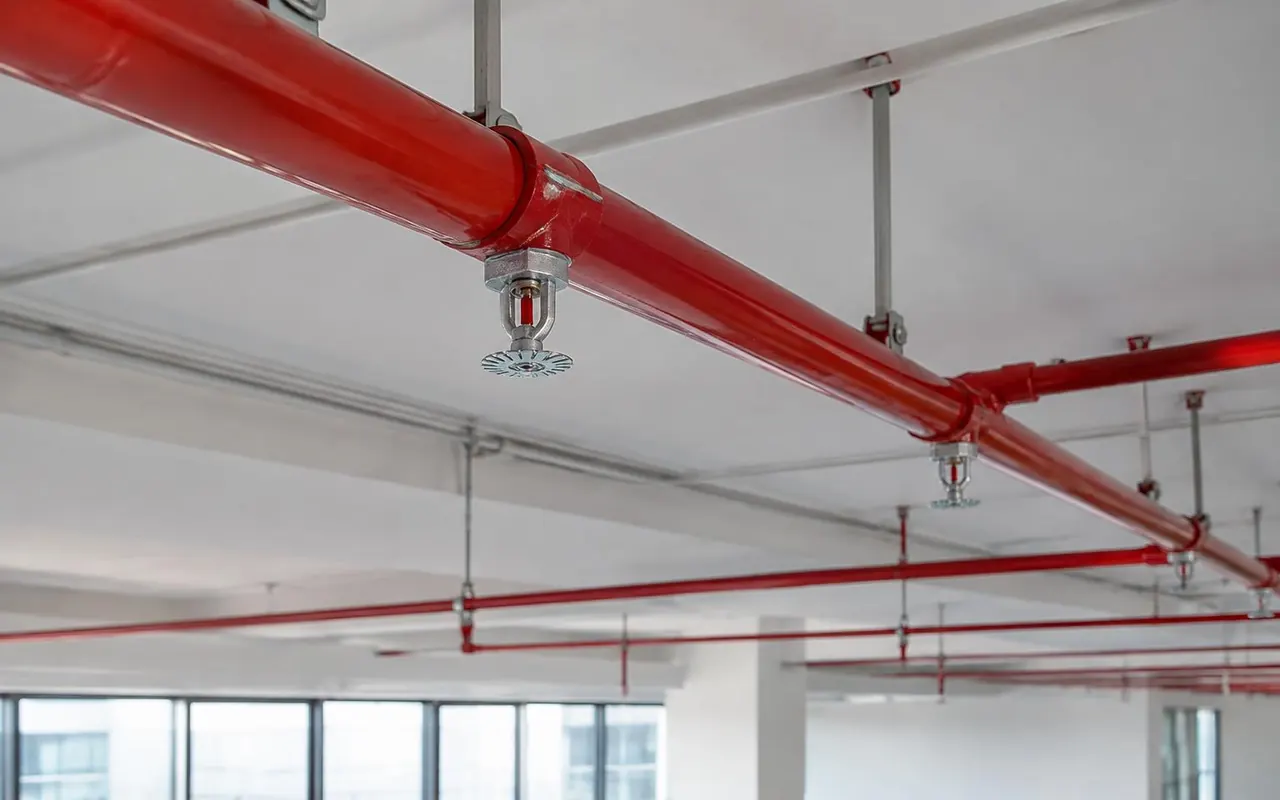
This page is part of our turnkey fire fighting projects range. Films have taught people that one sprinkler going off sets off every head in the building. It does not work that way. Each head has a small glass bulb or fusible link that breaks at a set temperature, and only that head sprays. A fire sprinkler system in Hyderabad controls most fires with just one or a few heads open. We plan sprinklers alongside the fire hydrant system, since both usually share one tank and pump room.
How a sprinkler head works
A sprinkler head is a valve held shut by a heat-sensitive part. In most heads that part is a glass bulb filled with liquid. As the fire heats the ceiling, the liquid expands, the bulb breaks and water sprays onto a deflector that spreads it in a circle.
Water flows through the pipe, past an alarm valve, which rings a gong and sends a signal to the fire alarm panel. Flow switches on each floor tell the guard which area is affected.
Wet pipe, dry pipe, pre-action and deluge
The type of system depends on what the building holds and how cold or sensitive the space is. Most Hyderabad buildings use wet pipe sprinklers. The other types solve special problems.
- System
- Wet pipe
- How it works
- Pipes always full of water, heads open on heat
- When it is used
- Offices, hotels, malls, basements, most warehouses
- System
- Dry pipe
- How it works
- Pipes hold air, water enters when a head opens
- When it is used
- Spaces where pipes could freeze, like cold stores
- System
- Pre-action
- How it works
- Detectors must trip first before water enters the pipes
- When it is used
- Data rooms, archives, museums
- System
- Deluge
- How it works
- All heads are open, water flows on a detector signal
- When it is used
- Transformer yards, fuel and chemical areas
Head types and temperature ratings
Heads come in several shapes. Pendent heads hang down from a ceiling, upright heads point up from exposed pipes, and sidewall heads mount on walls in corridors and hotel rooms. Concealed heads hide behind a flat cover plate that drops away in a fire, which suits lobbies and finished ceilings.
The bulb colour shows the opening temperature. Red bulbs at about 68°C suit most rooms. Hotter spaces, such as kitchens, boiler rooms or under skylights, need higher-rated heads.
High-rack warehouses often use ESFR heads, which stands for early suppression fast response. They deliver large drops of water that reach the base of tall racks, and they can sometimes remove the need for sprinklers inside the racks.
Hazard classes and design
Every sprinkler design starts with the hazard class. Light hazard covers offices, hotel rooms and hospitals. Ordinary hazard covers shops, car parks, basements and most factories. High hazard covers storage of plastics, foam, paper rolls and flammable goods, often stacked high.
The hazard class sets the spacing between heads, the water density, the area of operation and the water supply needed. A mistake here is costly, because a warehouse designed as ordinary hazard may not control a fire once its stock changes to plastic goods.
Water supply, pumps and the valve set
Sprinklers need a reliable source of water at the right pressure. Most buildings use a fire tank with electric and diesel pumps, often shared with the hydrants. Our fire pump house page explains how those pumps are arranged.
The main control is the installation valve set. It includes an alarm valve, a water motor gong, pressure gauges, a drain and a test valve. Each floor or zone has a flow switch and an isolation valve with a tamper switch, so the panel knows if anyone shuts it.
- Fire tank and pump set
- Installation valve set with alarm valve and gong
- Floor control valves with tamper switches
- Flow switches linked to the fire alarm panel
- Pipe network and sprinkler heads
- Test and drain points
Common sprinkler problems on existing sites
Interior changes cause most sprinkler problems we find. New partitions leave rooms with no heads, false ceilings go in below the heads, and decorators paint over bulbs. Painted heads may open late or not at all.
In warehouses, racks often grow taller than the original design allowed. Stock is then stored too close to the heads, which blocks the spray. A design review is needed whenever storage height or stock type changes.
Closed floor valves are the most serious finding. Tamper switches should warn the panel, but on older systems they are often missing or disconnected.
Testing and annual sprinkler service
New pipework is pressure tested before ceilings close. At commissioning we open the test valve on each zone and check that water flows, the gong rings, the flow switch reports to the panel and the pump starts.
On an annual service we check heads for paint, dust and damage and look for obstructions below them. We also test every flow switch and valve, run the pumps and inspect the valve set. Stock piled too close to the heads is a frequent finding in warehouses. For a wider check of the building, see our fire safety audit service.
Sprinkler projects across Hyderabad
Warehouses at Shamshabad and along the outer ring road need sprinklers sized for tall racks and changing stock. Many need ESFR heads or in-rack sprinklers, and the design must allow for future storage.
Malls, hotels and basement car parks in Hitech City, Banjara Hills and Jubilee Hills mostly use wet pipe systems with concealed heads in public areas. Data rooms and pharma plants around Gachibowli and Patancheru often need pre-action systems or a water mist system for sensitive equipment.
Sprinklers are checked during inspection by the Telangana State Disaster Response & Fire Services Department, and our fire NOC consultant page explains how we help with that. Our Gachibowli team designs and installs each fire sprinkler system in Hyderabad, and the Hyderabad office page lists our other services. For coastal sites, see our fire sprinkler system in Visakhapatnam page.
Areas we serve. Not sure we cover your area? Call the office and ask.
- Shamshabad
- Hitech City
- Banjara Hills
- Jubilee Hills
- Gachibowli
- Patancheru
Standards and approvals
We design to NBC 2016 Part 4 and IS 15105 for sprinkler design and installation, with NFPA 13 as a reference where the client asks for it. The fire department decides what each building needs, and Essatech does not issue or promise approval.
How the work runs
- Send drawingsShare floor plans, ceiling heights, stock and storage details.
- DesignWe set the hazard class, place heads and size pipes and pumps.
- QuoteYou get an itemised quote listing heads, pipes, valves, pumps and testing.
- InstallationPipes and heads go in before ceilings close, then the valve set.
- Testing and handoverWe pressure test, flow test each zone and hand over records for your fire sprinkler system in Hyderabad.
What affects the price
- Building height and area
- Hazard class
- Water source and tank size
- Pump duty, flow and head
- Pipe size and material
- Number of sprinkler heads
- Civil work
- Approvals and testing
What to send us
- Floor plans
- Building height and use
- Water storage and supply details
- Existing fire system details
- Fire department letters, if any
- Your deadline