

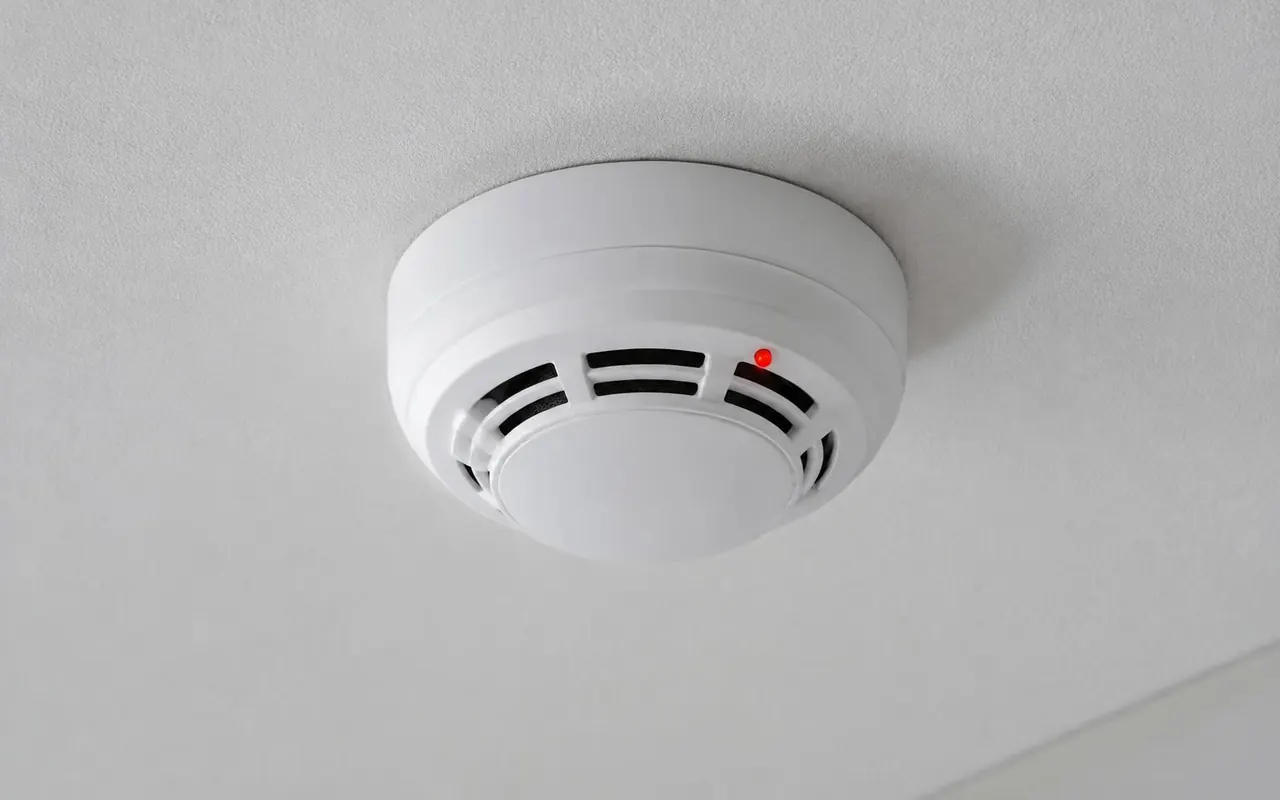
How a beam detector saves you work
A beam detector works on the principle of light obscuration. Its two parts face each other across the space, with a light beam passing between them. When smoke from an early-stage fire blocks enough of the light, the detector sends a signal.
One beam can watch a long line of ceiling, so it replaces many individual smoke detectors in a large space. That cuts the number of devices to install, wire and test, and lowers detection cost in these areas. If the beam is blocked completely, for example by a ladder or stock, most detectors report a fault instead of a fire, and staff clear the path.
Projected and reflective types
A projected beam detector has a transmitter on one side and a receiver on the other, so wiring is needed at both ends. A reflective type keeps both in one unit and bounces the beam off a reflector on the far wall, so wiring is needed on one side only. Reflective types suit spacious rooms, reception halls, department stores, cinemas, theatres, warehouses, arenas and churches.
Where we fit beam detectors
Beam detectors are used for smoke detection in large commercial and industrial buildings:
- Spacious rooms and function halls
- Open areas and open sheds
- High-ceiling spaces such as atriums and lobbies
- Warehouses and distribution sheds
- Hotels, towers and hospital atriums
- Industrial premises
What you get from Essatech
We handle the whole job, including the parts that are hard to get right on a tall ceiling:
- A free site survey, with measurements of span and ceiling height
- Beam positions planned at the right height, including a second level in very tall spaces where smoke may stall below the ceiling
- Supply, installation and alignment of every beam
- Commissioning with a calibrated test filter, and alarm and fault signals checked on the panel
- Alignment and lens checks on each service visit
Brands, range and compatibility
We supply beam detectors from Honeywell, Fire-Lite, Ravel, Morley-IAS, Notifier, GST, Tyco and Apollo. Range depends on the model. Many models cover tens of metres in a single beam, and some reach around a hundred metres, so the data sheet must match your span. The detector must also suit your fire alarm panel. Send us the panel make and model and we will confirm before quoting.
For builders, architects, MEP consultants, corporates, industries, hospitals and defence
Builders and architects of warehouses, atriums and halls should plan beam positions with the roof structure, because mounting walls must be firm and clear of obstacles. Industries use beams in large sheds and stores. Commercial building owners use them in lobbies and showrooms with high ceilings, and hospital owners in tall atriums and entrance halls, where ceiling heads are hard to reach and test. MEP consultants can send roof and ceiling drawings, and we return beam positions with mounting heights. Corporates use beams in atriums and exhibition halls. Defence sites, including Navy and Army hangars, drill halls and large stores, suit beams too, and we quote within their security and vendor rules.
What decides the cost
Beam detection usually costs less than a grid of ceiling heads in a big hall, but the saving depends on your building:
- The span and number of beams needed
- Projected or reflective type, and the make
- Mounting height, and whether a lift or scaffold is needed to reach it
- Panel type and cable length
When beam detection is the wrong fit
We tell you when beam detection will not work, so you do not pay for the wrong system. Avoid beams where any of these are present in normal use:
- High ambient light reaching the receiver
- Excessive dust, smoke or water vapour in the air
- Rapid temperature changes
- Mounting surfaces that vibrate or move
Beam detection in Hyderabad and Visakhapatnam
Warehouses and distribution sheds near Shamshabad and Patancheru, convention halls and atriums in Hitech City, and storage sheds around Gajuwaka and Autonagar in Visakhapatnam are typical places for beam detectors. Send the floor plan and ceiling heights through our quote page or contact our offices, and we will propose positions as part of a fire alarm system design.
Talk to our local team
Share your location, type of building and what you need. We will suggest the right equipment and explain installation and maintenance.