

A fire suppression system is a fixed installation that detects a fire and discharges an agent on it without a person acting. The agent, the delivery method and the room all differ by type. This guide gives each of the types of fire suppression systems a short definition, then its uses and limits. The fire suppression systems hub shows how the family fits together.
Clean agent systems
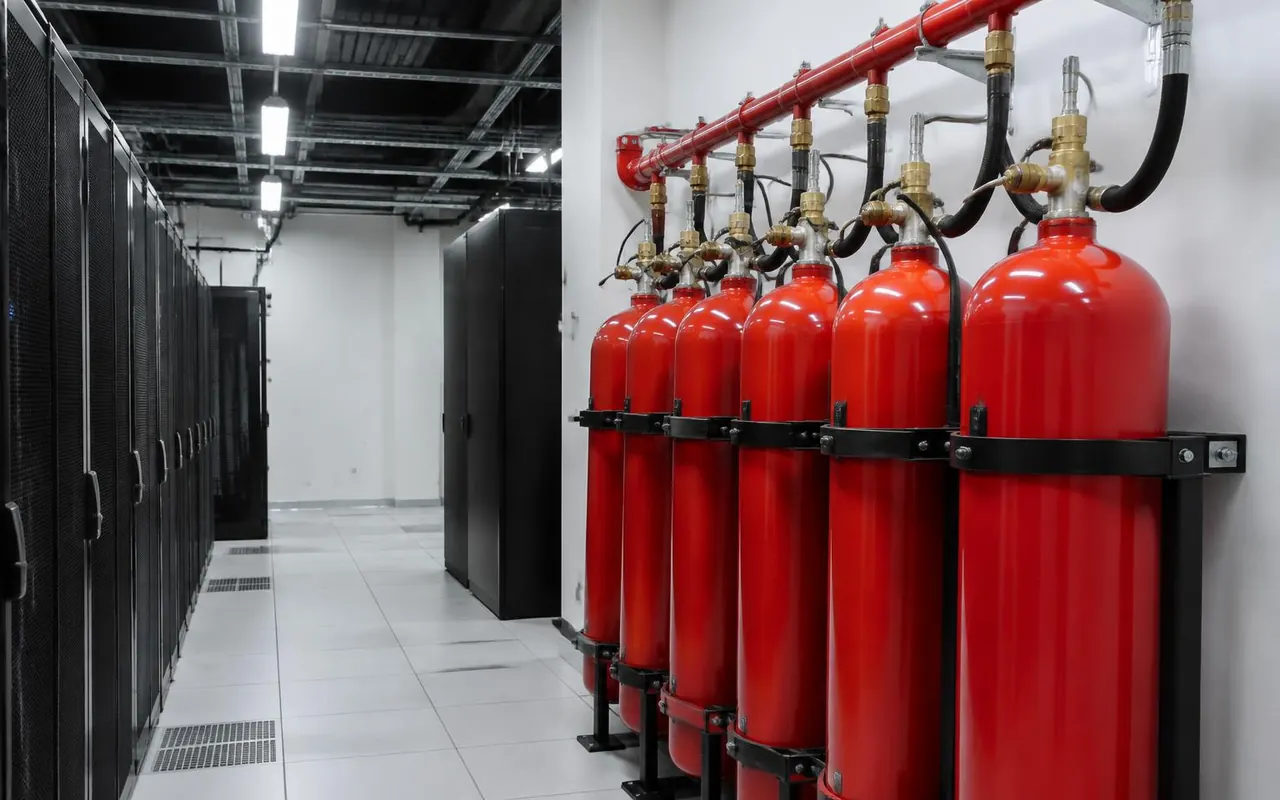
A clean agent system floods a sealed room with a gas that stops the fire and leaves no residue. The halocarbons are HFC-227ea, sold as FM200, and FK-5-1-12, the agent sold as Novec 1230. Discharge takes about 10 seconds.
Both are used in occupied rooms at a design concentration below the safety limit. Typical spaces are server rooms, control rooms and archives. HFC-227ea has a global warming potential over 3,000, which is why HFCs are being phased down under the Kigali Amendment. See clean agent suppression for the design detail.
Inert gas systems
An inert gas system lowers the oxygen in a room to a level that stops burning while people can still breathe for the short time needed to leave. The gases are IG-541, IG-55, IG-01 and IG-100.
They have zero ozone depletion and zero warming potential. The space penalty is real, because storage at 200 or 300 bar needs more cylinders than a halocarbon, and discharge runs 60 to 120 seconds with pressure relief vents. See inert gas systems.
CO2 flooding systems
CO2 flooding fills a room with carbon dioxide that smothers the fire. It is lethal at extinguishing concentration, so it is used only in spaces where nobody is present, such as DG rooms, turbine halls and cable galleries. Read about CO2 flooding for the controls.
Condensed aerosol systems
A condensed aerosol generator holds a solid compound that, once triggered, releases a fine potassium based aerosol that interrupts the flame chemistry. There is no pressurised cylinder and no pipe network. A fine residue needs cleaning, and rooms are evacuated before discharge. Small enclosed spaces suit this type, as our aerosol suppression page shows.
Wet chemical kitchen systems
A wet chemical system sprays a potassium based liquid over cooking appliances, hood plenum and duct. The liquid forms a soap layer on hot oil and cools it. UL 300 with NFPA 17A governs the system, and hoods follow NFPA 96. See kitchen hood suppression page.
Tube based systems
A tube based system runs a pressurised polymer tube through an enclosure. Heat at the fire point, in the region of 100 degrees C, bursts the tube. In a direct system the agent leaves through the burst point. In an indirect system the tube acts as a detector and opens a valve to separate nozzles. No power is needed, which suits panels, racks and machines. See tube based suppression.
Water mist and foam
Water mist sprays fine droplets that cool the fire and displace oxygen, using far less water than a sprinkler. Water mist systems suit hotels, hospitals and plant rooms. Foam blankets the surface of a flammable liquid. Bladder tank foam systems protect fuel stores and tank areas.
Sprinklers as the water baseline
A sprinkler system opens a heat-sensitive bulb over the fire and sprays water. It controls a building fire well but damages equipment, so server and switch rooms add a gas or local system. Our fire sprinkler page explains the water side.
Comparing the types of fire suppression systems
The table sets the types of fire suppression systems side by side, from agent to standard.
| Type | Agent | Safe for occupied rooms | Typical spaces | Standard |
|---|---|---|---|---|
| Clean agent | HFC-227ea, FK-5-1-12 | Yes, with alarm and delay | Server and control rooms | NFPA 2001, ISO 14520 |
| Inert gas | Nitrogen, argon blends | Yes, with alarm and delay | Data halls, archives | NFPA 2001, ISO 14520 |
| CO2 | Carbon dioxide | No | DG rooms, cable galleries | NFPA 12, IS 6382 |
| Condensed aerosol | Potassium based aerosol | Evacuate first | Small enclosed spaces | NFPA 2010 |
| Wet chemical | Potassium based liquid | Yes | Kitchen hoods | UL 300, NFPA 17A |
| Tube based | Clean agent, CO2, powder | Local use | Panels, racks, machines | Maker listing |
| Water mist | Fine water | Yes | Hotels, hospitals | Maker test report |
| Foam | Foam concentrate | Area dependent | Fuel stores | NBC 2016 Part 4 |
Engineered and pre-engineered systems
Among the types of fire suppression systems, an engineered system is designed for each room from flow calculations, so it can serve large or irregular spaces. A pre-engineered system is a factory tested kit with fixed limits on pipe length, nozzles and room size. Both need listed components used inside the maker's limits.
Where to get help
Essatech designs and services all the types of fire suppression systems above for sites in Hyderabad and Visakhapatnam. Hyderabad readers can use our fire suppression system in Hyderabad page. For FM200 against Novec, read FM200 vs Novec 1230.
Standards and approvals
NFPA 2001 and ISO 14520 cover clean agent and inert gas systems. NFPA 12 and IS 6382 cover CO2, NFPA 2010 covers aerosol, and UL 300 with NFPA 17A covers kitchen systems. Essatech supplies FM Approved and UL listed components. Approvals belong to specific models, so ask for the listing of the exact model quoted.
What to send us
- Plans of the rooms to protect
- What each room holds
- Room sizes and heights