

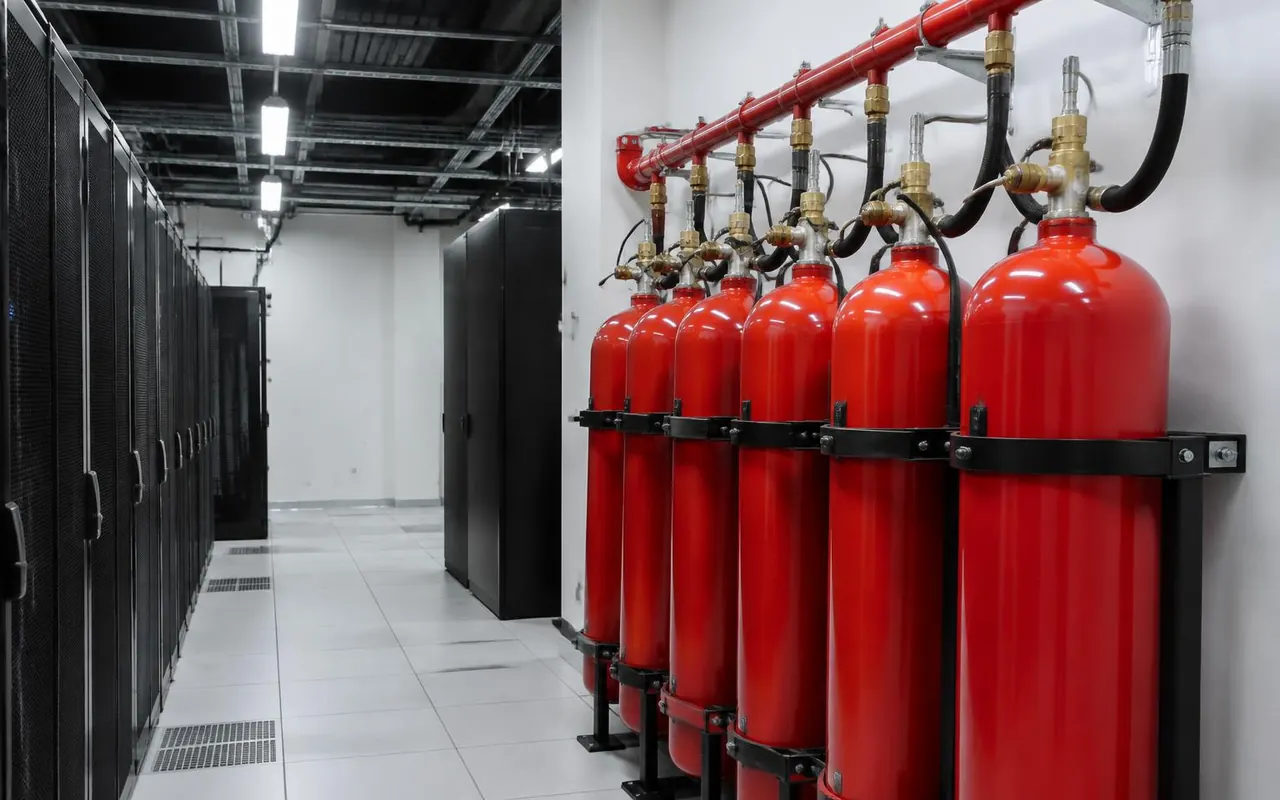
The FM200 vs Novec 1230 question is a common step in a server room or control room project. Both agents are halocarbons, both discharge in about ten seconds, and both are covered by NFPA 2001 and ISO 14520. The differences lie in environment, regulation and supply.
This guide compares them on facts you can check, and it avoids price claims. Use it with the maker's data for the exact system you plan to buy. The FM200 vs Novec 1230 choice rarely turns on fire performance.
Side-by-side comparison
The table lists the points that usually decide the choice. Agent names are given as sold and as chemical names.
- Point
- Chemical name
- FM200
- HFC-227ea
- Novec 1230
- FK-5-1-12
- Point
- How stored
- FM200
- Liquefied gas under pressure
- Novec 1230
- Liquid that turns to gas on discharge
- Point
- Occupied rooms
- FM200
- Used below the NOAEL safety limit
- Novec 1230
- Used below the NOAEL safety limit
- Point
- Cylinder space
- FM200
- Compact, similar to the other halocarbon
- Novec 1230
- Compact, similar to the other halocarbon
- Point
- Global warming potential
- FM200
- Over 3,000
- Novec 1230
- About 1
- Point
- Atmospheric life
- FM200
- Many years
- Novec 1230
- Days
- Point
- Regulation outlook
- FM200
- HFC phase-down under the Kigali Amendment
- Novec 1230
- Not an HFC, so not part of that phase-down
- Point
- Supply
- FM200
- Widely made and supplied
- Novec 1230
- 3M ended Novec production in 2025; other producers sell FK-5-1-12
- Point
- Typical rooms
- FM200
- Server rooms, control rooms, archives
- Novec 1230
- Same rooms, plus sites with environmental targets
Safety for people
Both agents are designed for use at a concentration below their no observed adverse effect level, known as NOAEL. This is why either can protect rooms where people work. The system still needs a pre-discharge alarm, a time delay, an abort switch and a manual release.
Neither removes the need to evacuate. Staff should leave when the hooter sounds, and a warning sign outside the door shows that gas has been released.
Cylinder space
Halocarbon systems use far less storage than inert gas. In practice the two agents need similar floor space, and the exact count depends on room volume and design concentration. If space is tight, ask for the cylinder layout of both options for the same room.
Large halls with room for many high-pressure cylinders may suit an inert gas system instead.
Environment and regulation
HFC-227ea has a global warming potential over 3,000. HFCs are being phased down under the Kigali Amendment, which India has ratified. We give no dates here, because they change with national rules.
FK-5-1-12 has a global warming potential of about 1 and an atmospheric life of days. Buyers with sustainability goals often prefer it for that reason.
Supply and service
3M stopped making Novec products at the end of 2025 as part of its PFAS exit. FK-5-1-12 is still made and sold by other producers under other names. So if you search for a Novec 1230 replacement, you are really asking for FK-5-1-12 from another source.
Ask any supplier who will refill your cylinders, how long it takes and whether parts are stocked. Service is as important as the first purchase.
Which to choose
In the FM200 vs Novec 1230 decision, if your site follows an environmental target, or you want to avoid a future regulatory change, FK-5-1-12 is the stronger fit. If an existing room already runs on FM200 and the system is sound, keep it in service and plan its refills. For a new room with no environmental brief, both work, so decide on supply, service and the approvals your insurer names.
For a wider choice including CO2, read our FM200, CO2 and inert gas guide. Local pages cover FM200 in Hyderabad, Novec 1230 in Hyderabad and the wider clean agent family. For room design, see server room protection, and our team in Visakhapatnam can survey sites there too.
Standards and approvals
NFPA 2001 and ISO 14520 cover the design of halocarbon and inert gas systems. Approvals belong to specific models, so we share the FM or UL listing for the exact model we quote, and match the approval your insurer or consultant specifies.
What to send us
- Room size and ceiling height
- Existing agent and cylinder details
- Insurer or consultant requirements