

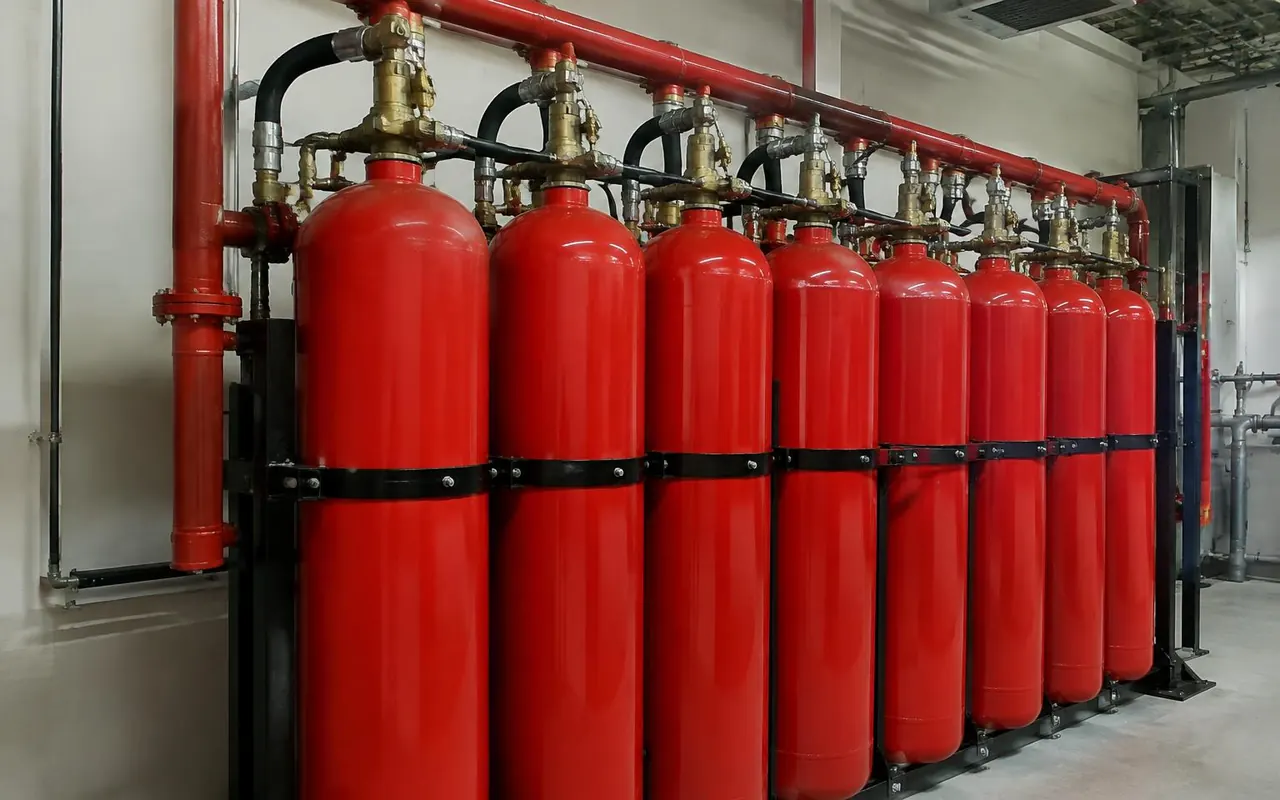
An inert gas fire suppression system in Hyderabad takes a different route from the halocarbons. Instead of absorbing heat, the gas displaces oxygen to a level where flames die but people can still breathe for the short time needed to leave.
The agents are already in the air, so nothing synthetic is released. This page covers the gases, the trade-offs in space and discharge time, and the design points that matter. For the other families, see our clean agent overview.
The gases and what each one is
IG-541 is a blend of nitrogen, argon and a small share of CO2. IG-55 is half nitrogen and half argon, often sold as Argonite. IG-01 is pure argon, and IG-100 is pure nitrogen.
Each has its own design factors, so cylinders, nozzles and flow software come as a matched set. The table sets out the differences.
- Agent
- IG-541
- Makeup
- Nitrogen, argon, CO2
- Typical note
- The CO2 share helps breathing during discharge
- Agent
- IG-55
- Makeup
- Nitrogen and argon
- Typical note
- Widely used for data rooms and archives
- Agent
- IG-01
- Makeup
- Argon
- Typical note
- Heavier than air, single gas supply
- Agent
- IG-100
- Makeup
- Nitrogen
- Typical note
- Simplest gas, lowest extinguishing efficiency
Cylinders, space and discharge
Inert gas stays a gas inside the cylinder, so it needs a large number of high pressure cylinders at 200 or 300 bar. A room that a halocarbon would protect with two cylinders may need many more. Plan a cylinder store with a firm floor and good ventilation.
Discharge is slower, about 60 to 120 seconds, because the gas must build up gradually. This is acceptable for most rooms, since the fire is detected early. It does mean the detection layer matters, and aspirating smoke detection is a common partner.
Pressure relief venting
A large volume of gas entering a sealed room raises the pressure. Without a way out, the pressure can push on doors, glass and ceiling tiles. Pressure relief vents open during discharge and close again afterward.
Vent size comes from the room volume and flow rate. It must lead to a safe place, not into an escape corridor.
One bank, several rooms
Because the gas travels well through long pipes, one central cylinder bank can serve several rooms through selector valves. When a fire is detected, the valve for that room opens and only that room is flooded.
This suits a floor with a data hall, a UPS room and a control room, with one cylinder store to maintain. The comparison of agent families is in our FM200 vs CO2 vs inert gas guide.
Choosing inert gas
Pick an inert gas fire suppression system in Hyderabad where climate impact matters, where a long pipe run is needed or where one bank must serve many rooms. Pick a halocarbon such as FM200 where cylinder space is tight. Use CO2 flooding only in rooms where nobody is present.
Inert gas projects across Hyderabad
Enquiries for an inert gas fire suppression system in Hyderabad come from Hitech City, Kondapur and Nanakramguda, where sites often have a plant floor for a cylinder store. Pharma and lab buildings in Patancheru and Jeedimetla also ask for inert gas for archives and instrument rooms.
Our Hyderabad team at Gachibowli surveys the room, checks where a cylinder bank and vents can go, and draws the pipe layout. Protect server halls in line with our server room fire suppression approach, with detection linked to release.
Areas we serve. Not sure we cover your area? Call the office and ask.
- Hitech City
- Kondapur
- Nanakramguda
- Patancheru
- Jeedimetla
- Gachibowli
Standards and approvals
Any inert gas fire suppression system in Hyderabad follows NFPA 2001 and ISO 14520, with detection to NFPA 72. High pressure cylinders need periodic hydrostatic testing as the cylinder rules require. Approvals belong to specific models, so we share the FM or UL listing for the exact model we quote.
The Telangana State Disaster Response & Fire Services Department issues the fire NOC and inspects the building. Essatech prepares the drawings and records. Plan servicing early through an AMC for suppression systems.
How the work runs
- Send drawingsSend floor plans for each room, with heights and the space you can spare for a cylinder store.
- Survey and designWe measure the rooms, choose the gas, size the cylinder bank, and place vents and selector valves.
- ProposalYou get the pipe layout, the flow calculation summary and the listing for the equipment we propose.
- InstallationWe mount cylinders on the frame, run high pressure pipe, fit nozzles, vents and the control panel.
- Test and hand overWe check the room seal, test alarms and delays, and train your team before handing over the records.
Brands we supply
- Brand
- Siemens
- How we work with it
- We supply and install this brand
- Brand
- Rotarex
- How we work with it
- We supply and install this brand
- Brand
- Safepro
- How we work with it
- We supply and install this brand
What to send us
- Floor plans with room heights
- Space available for a cylinder store
- List of rooms to protect from one bank
- Existing fire alarm and detector details