

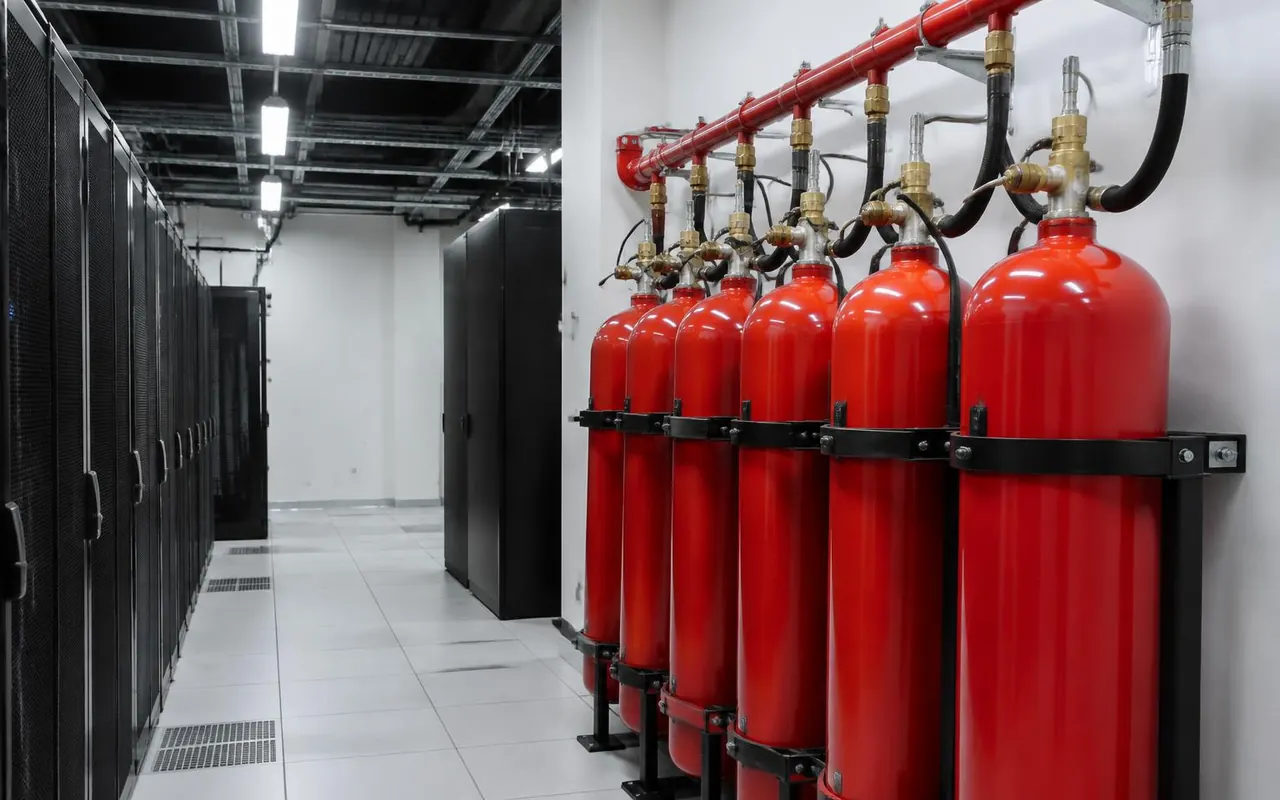
Water damages servers and paper, and powder clogs fans and boards. A clean agent fire suppression system in Hyderabad avoids both. It puts out the fire as a gas, then clears from the room when the doors are opened.
This page is the overview. It explains the two agent families, how to choose between them and what the room must be like for the system to work. For the individual agents, see our FM200 gas suppression system, the Novec 1230 page and the inert gas page.
What clean agent means
The word clean describes what is left after discharge. The agent is a gas or a vapour, so nothing needs to be wiped off. It does not conduct electricity, which is why it can be released over live racks and switchgear.
The system works by absorbing heat or by thinning the oxygen, depending on the family. In both cases the fire is stopped in seconds and the room is ready to be ventilated and checked. Design rules are set by NFPA 2001 and ISO 14520.
The two agent families
Halocarbons are stored as a liquid in a cylinder and turn to gas as they leave the nozzle. HFC-227ea, sold as FM200, and FK-5-1-12 belong here. They discharge within about 10 seconds and need modest cylinder space.
Inert gases are natural gases held at high pressure. IG-541 is a blend of nitrogen, argon and CO2, IG-55 is nitrogen and argon, and IG-01 is argon. They take more cylinders and a longer discharge, but they carry no global warming potential.
- Point
- Examples
- Halocarbon
- HFC-227ea (FM200), FK-5-1-12
- Inert gas
- IG-541, IG-55, IG-01
- Point
- Storage
- Halocarbon
- Liquid in cylinders
- Inert gas
- Gas at 200 or 300 bar
- Point
- Discharge time
- Halocarbon
- About 10 seconds
- Inert gas
- About 60 to 120 seconds
- Point
- Cylinder space
- Halocarbon
- Smaller footprint
- Inert gas
- More cylinders needed
- Point
- Climate impact
- Halocarbon
- FM200 is high, FK-5-1-12 is very low
- Inert gas
- Zero global warming potential
- Point
- Room venting
- Halocarbon
- Usually modest
- Inert gas
- Pressure relief vents required
How to pick between them
Choosing a clean agent fire suppression system in Hyderabad starts with space. A plant room with little floor area favours a halocarbon, because the cylinder bank is smaller. A site with a large cylinder store and several rooms to protect may prefer inert gas from one central bank.
Then look at climate rules and the client's own policy. HFCs are being phased down under the Kigali Amendment, which India has ratified, so many buyers now ask about FK-5-1-12 or inert gas. Our FM200 vs Novec 1230 guide sets the two halocarbons side by side.
Room sealing and the integrity test
A clean agent only works if it stays in the room long enough. Gaps around cable entries, ducts and ceiling voids let it leak out. The fix is to seal penetrations, fit dampers on air ducts and close the room on alarm.
After installation a door fan test measures how long the agent will hold. The test is repeated when the room layout changes.
Clean agent protection across Hyderabad
Most enquiries for a clean agent fire suppression system in Hyderabad come from IT floors and data rooms in Hitech City, Gachibowli and the Financial District. Banks and records stores in Banjara Hills and Secunderabad also ask for it, mainly for archives and cash-counting areas.
Our Hyderabad team works from the Gachibowli office, so site surveys across these areas are quick to schedule. Larger floors need a manifold and a planned pipe layout, which we draw before any work starts.
Our server room fire suppression page covers detection and two-zone release. For hand-held cover, see the clean agent fire extinguisher page.
Areas we serve. Not sure we cover your area? Call the office and ask.
- Hitech City
- Gachibowli
- Financial District
- Banjara Hills
- Secunderabad
- Madhapur
Standards and approvals
NFPA 2001 and ISO 14520 cover design, installation, testing and maintenance of any clean agent fire suppression system in Hyderabad. NBC 2016 Part 4 sets the wider fire safety rules for the building. Detection follows NFPA 72.
The Telangana State Disaster Response & Fire Services Department issues the fire NOC and inspects the building. Essatech prepares the drawings and records for that process. See our fire NOC consultant page for how the steps fit together.
How the work runs
- Send drawingsShare the room plan, the height to the ceiling and the equipment list so we can see volume and risk.
- Survey and designOur engineers visit, check sealing and venting, choose the agent family and size the cylinders and pipe network.
- ProposalYou receive drawings, a bill of materials and the FM or UL listing for the exact model we propose.
- InstallationWe fit cylinders, pipes, nozzles, detection, alarms and the release panel, then seal the room openings.
- Test and hand overWe run the door fan test, check the interlocks and train your staff before handing over the records.
Brands we supply
- Brand
- Siemens
- How we work with it
- We supply and install this brand
- Brand
- Rotarex
- How we work with it
- We supply and install this brand
- Brand
- Safepro
- How we work with it
- We supply and install this brand
What to send us
- Room plan with length, width and height
- List of equipment and cabling inside the room
- Photos of doors, ducts and cable entries
- Existing fire alarm or detection details