

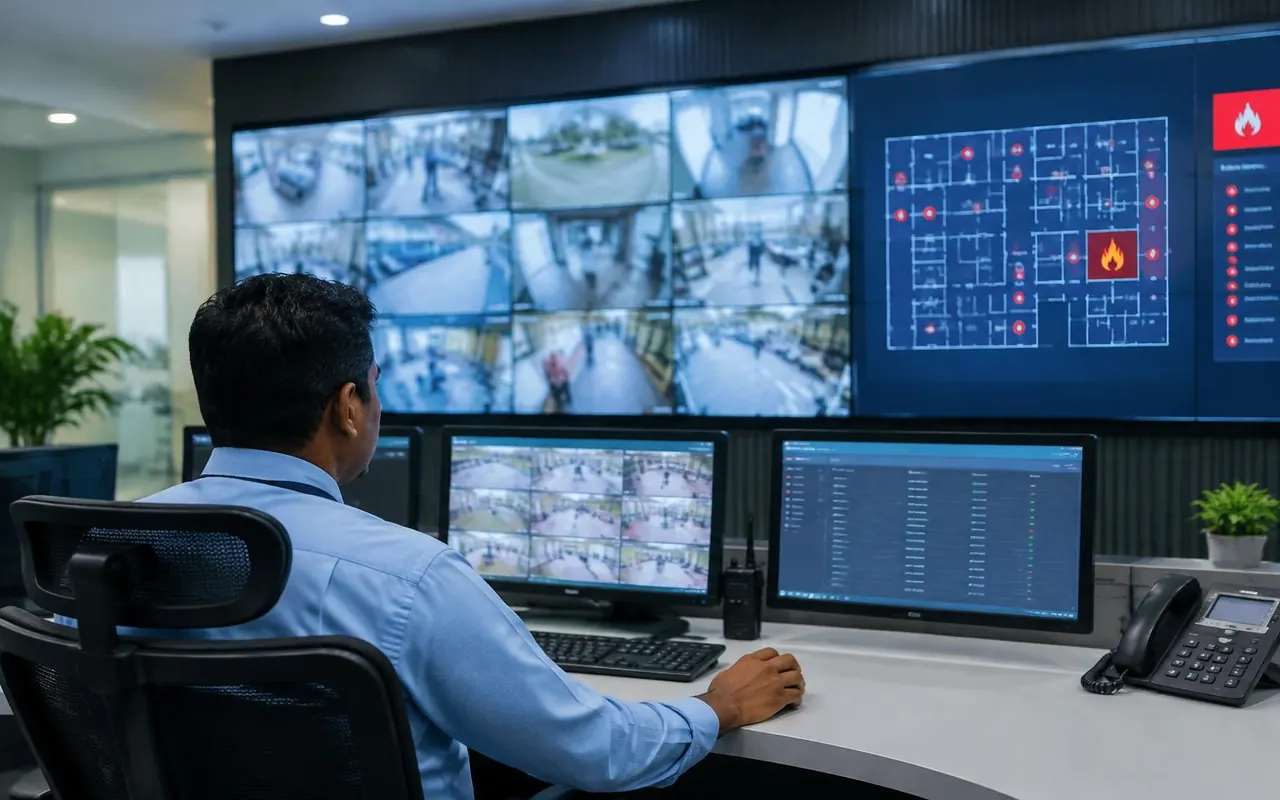
A manned area fire suppression system in Hyderabad is judged first on safety and second on speed. The agent must be one that people can be near, and the controls must give everyone time to leave.
This page explains which agents are allowed, what the safety limit means and the order of events from first alarm to discharge. For the agents themselves, see the clean agent overview and the inert gas page.
Which agents suit occupied rooms
For a manned area fire suppression system in Hyderabad, halocarbons such as FM200 and FK-5-1-12 are the usual choice because the design concentration sits below the safety limit. Inert gases are used too, since oxygen stays at a level people can survive while they walk out.
CO2 is different. At extinguishing concentration it is lethal, so it is only for rooms where nobody is present, such as generator rooms and cable galleries. Condensed aerosol also needs the room evacuated first. See CO2 flooding for where those fit.
NOAEL in simple terms
NOAEL stands for no observed adverse effect level. It is the highest concentration of an agent at which tests found no harmful effect on people. Designers keep the planned concentration below this figure for rooms that may be occupied.
A system for an occupied room also assumes the worst case, a person still inside at discharge. The pre-discharge steps exist so that rarely happens.
From detection to discharge
The sequence follows the same order in every well designed system.
- Detection: the first detector sees smoke and sounds the first alarm.
- Confirmation: a second detector in another zone confirms the fire.
- Pre-discharge: hooters and strobes start and the countdown begins.
- Delay: staff leave and doors close while the timer runs.
- Discharge: the agent is released and the gas released lamp lights outside.
The controls that protect staff
Each control has one job. The table lists them so a facility manager can check a design against it.
- Control
- Pre-discharge alarm
- What it does
- Warns everyone inside with a hooter and strobe
- Control
- Time delay
- What it does
- Gives people time to leave before the gas flows
- Control
- Abort switch
- What it does
- Held pressed to pause the countdown on a false alarm
- Control
- Manual release
- What it does
- Lets a person discharge by hand at the exit
- Control
- Lock-off
- What it does
- Disables release while engineers work in the room
- Control
- Gas released lamp
- What it does
- Tells people outside not to enter
- Control
- Door signs
- What it does
- Show the agent used and the warning meaning
Drills and everyday habits
A system is only as safe as the people who know it. Staff should know the alarm sound, the exit route and the meaning of the abort switch. Run a short drill after installation and again each year.
Visitors and contractors need a briefing too. Put the lock-off in the maintenance procedure, and never prop a protected room door open, as that weakens both the safety and the gas hold time.
Occupied room protection across Hyderabad
A manned area fire suppression system in Hyderabad is most often requested for control rooms and network operations centres in Hitech City, Madhapur and the Financial District. Banks and treasury rooms in Banjara Hills and Begumpet ask for the same controls on small vault and records rooms.
The Hyderabad office team in Gachibowli reviews your room, shift pattern and exit routes. Detection comes from your addressable fire alarm or a dedicated release panel, with the two-zone logic described above.
Areas we serve. Not sure we cover your area? Call the office and ask.
- Hitech City
- Madhapur
- Financial District
- Banjara Hills
- Begumpet
- Gachibowli
Standards and approvals
Design of a manned area fire suppression system in Hyderabad follows NFPA 2001 and ISO 14520, which set safety limits, pre-discharge alarms, delays and lock-off. CO2 systems follow NFPA 12 and IS 6382. Detection follows NFPA 72, and the building rules are in NBC 2016 Part 4.
The Telangana State Disaster Response & Fire Services Department issues the fire NOC and inspects the building. Essatech prepares the drawings and records. Our fire alarm system page covers the detection side.
How the work runs
- Send drawingsSend the room plan, exit doors and how many people work there on each shift.
- Survey and designWe walk the exit routes, choose a people-safe agent and place the alarms, strobes and switches.
- ProposalYou get the drawings, a sequence of operation and the listing for the equipment we propose.
- InstallationWe fit the cylinders, nozzles, detection, hooters, abort and manual release points, and door signs.
- Test and hand overWe test each alarm and delay, run a drill with your staff and hand over the records.
Brands we supply
- Brand
- Siemens
- How we work with it
- We supply and install this brand
- Brand
- Rotarex
- How we work with it
- We supply and install this brand
- Brand
- Safepro
- How we work with it
- We supply and install this brand
What to send us
- Room plan showing exits and door swing
- Number of staff per shift
- List of equipment inside the room
- Existing alarm panel make and model