

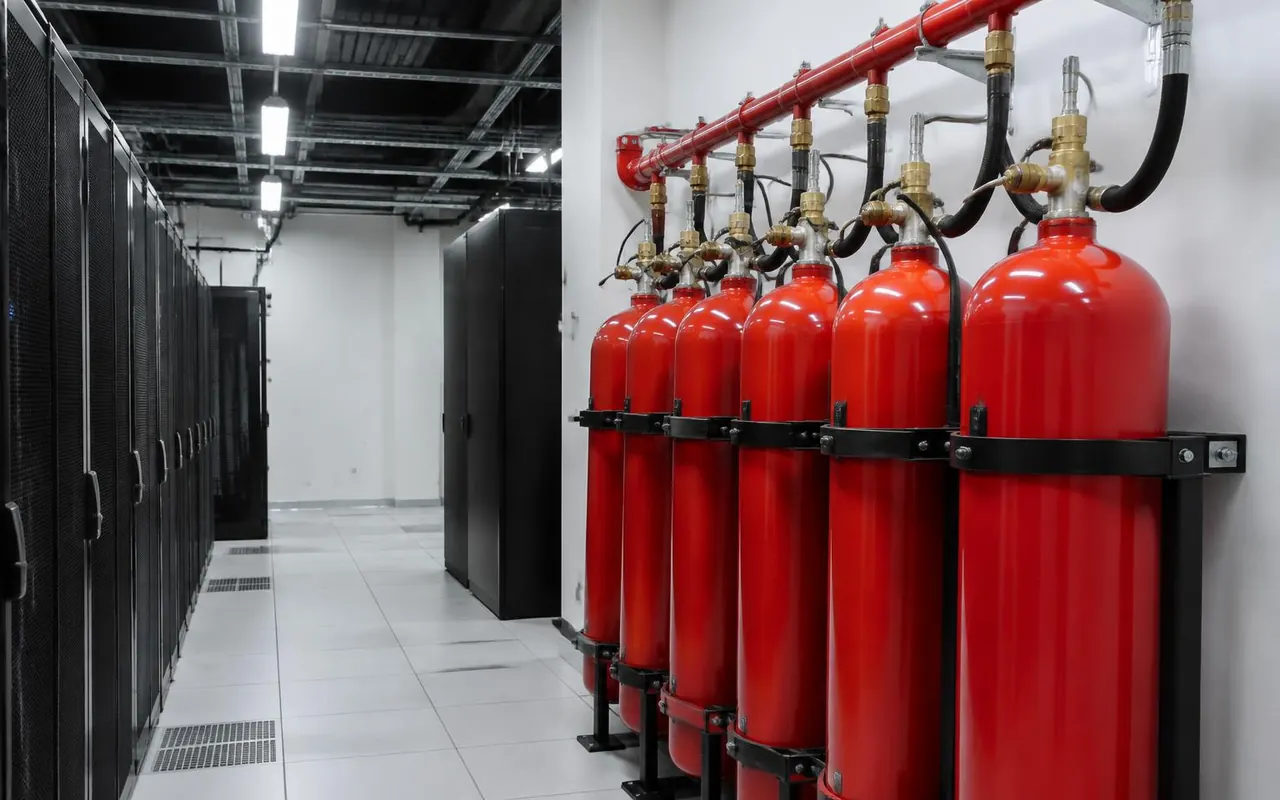
Server rooms, switch rooms and fryer lines need agents chosen for their hazards. This page links each family to its service page.
If your site is in Hyderabad, start with our fire suppression system in Hyderabad page. For plain definitions and a side by side comparison, read the guide to types of fire suppression systems.
Specialist suppression
What a fire suppression system does
A suppression installation has three working parts. Detectors sense heat, smoke or flame. A control panel confirms the alarm, warns people and opens the valves. Stored agent then travels through pipes or a tube to nozzles over the hazard.
An automatic fire suppression system differs from a sprinkler in purpose. Sprinklers control a general building fire with water. A suppression system protects one hazard, such as a switch room or a cooking line, with an agent suited to it. Both often share a building with a fire alarm system.
The main families of agent
Gaseous fire suppression floods a sealed room. Clean agents are halocarbons such as HFC-227ea, sold as FM200, and FK-5-1-12, the agent sold as Novec 1230. Both are used in occupied rooms at a design concentration below their safety limit. Inert gases such as IG-541 and IG-55 lower the oxygen level instead. CO2 is the third gas choice, and it is lethal at extinguishing concentration, so it stays in rooms that nobody enters.
Condensed aerosol generators release a fine potassium based aerosol and need no cylinder or pipe network. Wet chemical systems guard kitchen hoods and ducts. Tube based systems use a pressurised polymer tube that bursts at the fire point and need no power. Water mist cools with fine droplets, and foam covers flammable liquid.
Choosing a system by space
Ask whether people are present when the system fires, and what the room holds. This table shows the usual match.
| Space | Occupied? | Usual system | Standard |
|---|---|---|---|
| Server or network room | Often | Clean agent or inert gas | NFPA 2001, ISO 14520 |
| DG room, cable gallery, paint booth | No | CO2 or condensed aerosol | NFPA 12, NFPA 2010 |
| HT or LT switch room | Rarely | CO2 or clean agent | NFPA 12, NFPA 2001 |
| Panel, server rack, CNC machine | No | Tube based system | Maker listing |
| Restaurant or hotel kitchen hood | Yes | Wet chemical | UL 300, NFPA 17A |
Engineered and pre-engineered suppression systems
Engineered systems are designed room by room from flow calculations. Pre-engineered systems are factory tested kits that come with fixed limits on pipe length, nozzle count and room size. Large or irregular rooms usually take the engineered route, while a panel or a kitchen hood suits a pre-engineered kit.
Industrial fire suppression
Diesel generator rooms, turbine halls and paint lines suit CO2 flooding or aerosol. See electrical fire suppression for switch rooms.
Fire suppression pages for Hyderabad
Data rooms are the most common request, covered by server room fire suppression. Restaurants can read about kitchen hood fire suppression, and cabinets suit tube based fire suppression.
- Fire Suppression System in Hyderabad
- Clean Agent Fire Suppression System in Hyderabad
- Novec 1230 Fire Suppression System in Hyderabad
- FM200 Gas Suppression System in Hyderabad
- Inert Gas Fire Suppression System in Hyderabad
- CO2 Flooding System in Hyderabad
- Manned Area Fire Suppression System in Hyderabad
- Aerosol Fire Suppression System in Hyderabad
- Tube Based Fire Suppression System in Hyderabad
- Kitchen Hood Fire Suppression System in Hyderabad
- Electrical Fire Suppression System in Hyderabad
- Electrical Panel Fire Suppression in Hyderabad
- Server Room Fire Suppression in Hyderabad
- Lithium Battery Fire Suppression in Hyderabad
- Water Mist System in Hyderabad
- Bladder Tank Foam System in Hyderabad
- Fire Suppression AMC in Hyderabad
Fire suppression pages for Visakhapatnam
Coastal and port sites can start here.
Brands and approvals
We supply and install Ansul, Rotarex, Siemens, Safepro and Swastik equipment.
Essatech supplies FM Approved and UL listed systems and components. Approvals belong to specific models, so we share the FM or UL listing for the exact model we quote, and match the approval your insurer or consultant specifies.
Standards and approvals
Buildings are planned to NBC 2016 Part 4, with the gas, aerosol and kitchen standards in the table above. In Hyderabad the Telangana State Disaster Response & Fire Services Department issues the NOC and inspects the finished work. Essatech prepares drawings and records and does not issue or promise approval.
How the work runs
- Send drawingsShare plans, room sizes and what each room holds.
- Survey and designOur engineers visit and choose the route.
- ProposalYou receive a layout, equipment list and model listings.
- InstallationOur own team fits detection, pipes, nozzles and controls.
- Test and hand overWe test with you present and hand over records.
Brands we supply
- Brand
- Ansul
- How we work with it
- We supply and install this brand
- Brand
- Rotarex
- How we work with it
- We supply and install this brand
- Brand
- Siemens
- How we work with it
- We supply and install this brand
- Brand
- Safepro
- How we work with it
- We supply and install this brand
- Brand
- Swastik
- How we work with it
- We supply and install this brand
What to send us
- Plans or sketches of the rooms to protect
- Room sizes, heights and what each room holds
- Whether people work in the room
- Make and model of your fire alarm panel