

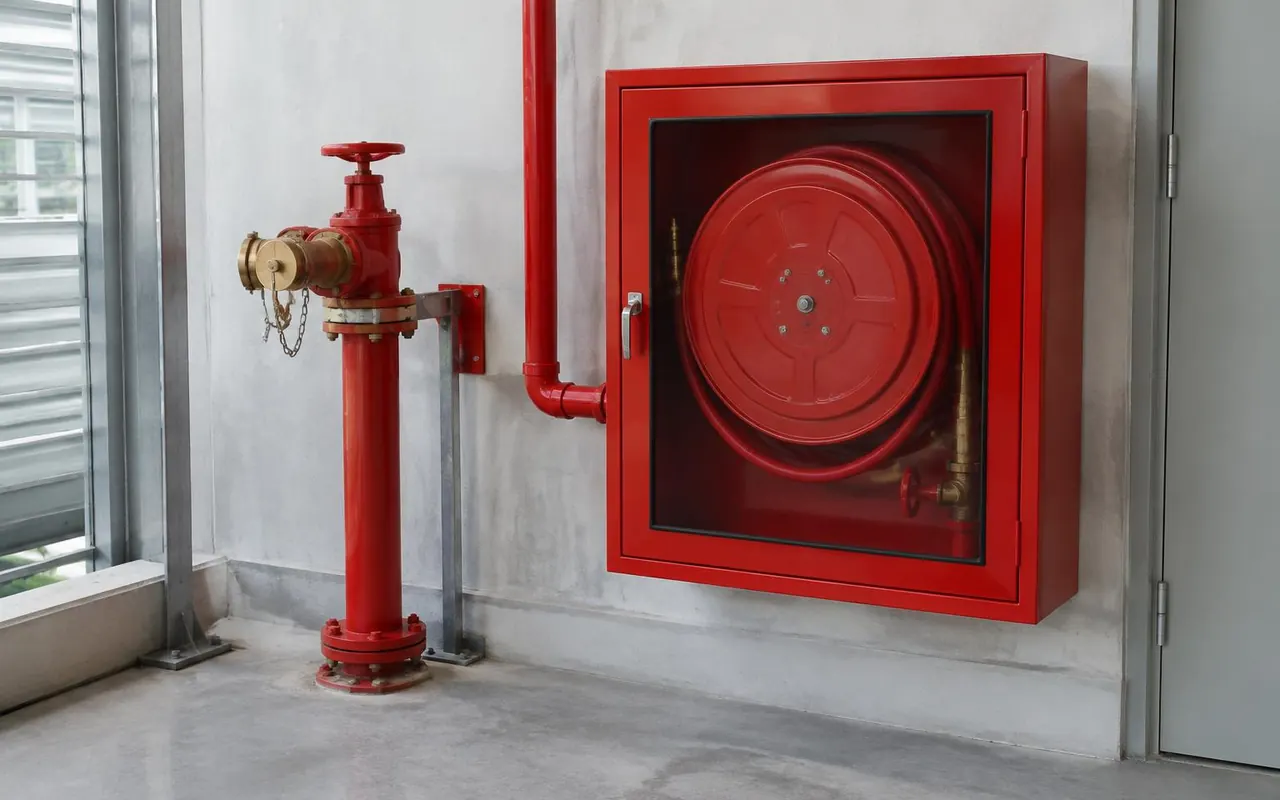
This page is part of our turnkey fire fighting projects range. Hydrant work in Vizag starts with the water, not the pipes. A fire hydrant system in Visakhapatnam is only as good as its tank, its pumps and the valves nobody should ever close. On the first visit we look at all three, then plan the pipework around them. The pump room is covered in more detail on our fire pump house page.
Wet riser, down-comer and yard hydrant
These three names cause most of the confusion we hear on site. A wet riser is a vertical pipe kept full of water under pressure, with a landing valve and hose reel on each floor. A down-comer is a smaller pipe fed from a terrace tank, used in some mid-rise buildings. Outside the building, a yard hydrant sits on a ring main around the block or plant.
Which one you need depends on building height, use and floor area, as set out in the fire code and your approved drawings. Large plants and campuses usually need both internal risers and an external yard ring. You can read more about the parts on our fire hydrant equipment page.
Why there are three fire pumps
The jockey pump is small and keeps the pipes at pressure, so minor leaks do not start the big pumps. When a hydrant valve opens and pressure drops further, the main electric pump starts. The diesel pump is the standby for a power cut or an electric pump fault.
Each pump starts on a pressure switch setting. Those settings must be staggered, or the pumps start in the wrong order or hunt on and off. A flat jockey pump setting is one of the faults we find most often, and it wears the main pump out early.
How big the water tank needs to be
Tank size is a design output, not a number to copy from another building. The inputs are building height, floor area, hazard class and how long the system must run at its design flow. A pharma unit at Parawada will need a very different figure from a five-floor office in Dwaraka Nagar.
We work the figure out from the code and your drawings, then check that the civil tank, its suction pipes and the pump room can deliver it. Where hydrants and sprinklers share one tank, the design has to allow for both. Our fire sprinkler system in Vizag page explains how sprinklers are sized.
Pipe, valves, hose reels and hose boxes
Above ground we use heavy-grade MS pipe, welded or grooved, painted fire red and fixed on supports that will not sag. Buried pipe needs wrapping and coating against soil and water. Every landing valve should open freely, and every hose box should hold its hoses and branch pipe, not old cartons.
Hose reels are for staff to fight a small fire before it grows. Landing valves are for the fire brigade. Both need clear access, so we check that stores, shutters or parked bikes do not block them once the building is in use.
Testing a fire hydrant system in Visakhapatnam before inspection
New pipework gets a hydraulic pressure test before it is painted and closed in. Then we run a flow test at the farthest and highest landing valve, to prove pressure and flow at the worst point. The last test is the pump start sequence of jockey, then electric, then diesel, each at its set pressure.
On inspection, the fire officer usually opens a landing valve, watches the pumps start and looks at the pump room, the tank and the hose boxes. We prepare the test records so they are ready on the day.
Mistakes we see on old hydrant systems
Closed isolation valves top the list. Someone shuts a valve to fix a leak and nobody opens it again, so half the building has no water. Rusted pipe on terraces and in basements comes next, followed by pumps left in manual mode.
None of these show up until there is a fire or a test. A regular fire safety audit and a fire safety AMC catch them early, and the fire alarm system can report pump running and fault signals to the guard.
Hydrant systems for Vizag ports, plants and towers
Industry shapes most hydrant work in this city. Port-side warehouses and steel-linked units around Gajuwaka, pharma plants at Parawada and new factories near Anakapalli all need yard hydrant rings and large pump rooms. Many also need foam or sprinkler protection for stores of solvents or packed goods.
Salt air is the big local problem. Bare or poorly painted pipe near the coast rusts at joints and supports within a few seasons. We specify proper surface preparation, primer and finish paint, and galvanised or stainless fixings where the air is worst.
Residential towers in Madhurawada and Rushikonda, and hotels near the beach, need wet risers and terrace tanks planned around the lift core and staircases. A fire hydrant system in Visakhapatnam for these buildings is checked by the Andhra Pradesh Fire Services Department, with building permission through GVMC or VMRDA.
Our Suryabagh head office runs these projects, and the Visakhapatnam office page lists all our services here. We also build hydrant systems in Hyderabad.
Areas we serve. Not sure we cover your area? Call the office and ask.
- Gajuwaka
- Parawada
- Anakapalli
- Madhurawada
- Rushikonda
- Autonagar
Standards and approvals
A fire hydrant system in Visakhapatnam follows NBC 2016 Part 4, with IS 3844 for internal hydrants and IS 13039 for external hydrants. NFPA 14 and NFPA 20 serve as references for standpipes and fire pumps. Only the fire department issues the NOC, and we cannot promise approval. Our fire NOC consultant in Visakhapatnam page explains how we prepare the file.
How the work runs
- Site visitAn engineer checks the water source, tank, pump room space, building height and access for the fire brigade.
- Hydraulic designWe size the pumps and pipes from the code and your drawings, and mark every hydrant, landing valve and hose reel.
- Quote and planYou get an itemised quote and a work plan that fits around the civil work and your operations.
- InstallationPipework, pumps, valves and panels go in, followed by the hydraulic pressure test and painting.
- Testing and handoverWe run the flow test and the pump start sequence with you, then hand over drawings, test reports and a pump room log book.
What affects the price
- Building height and floor area
- Hazard class of the building or plant
- Water source and tank size
- Pump duty (flow and head) and diesel standby
- Pipe size, material and length
- Number of landing valves, yard hydrants and hose reels
- Civil work, approvals and testing
What to send us
- Floor plans and site layout
- Building height and use
- Water storage and supply details
- Details of any existing fire system
- Fire department letters, if any
- Your deadline