

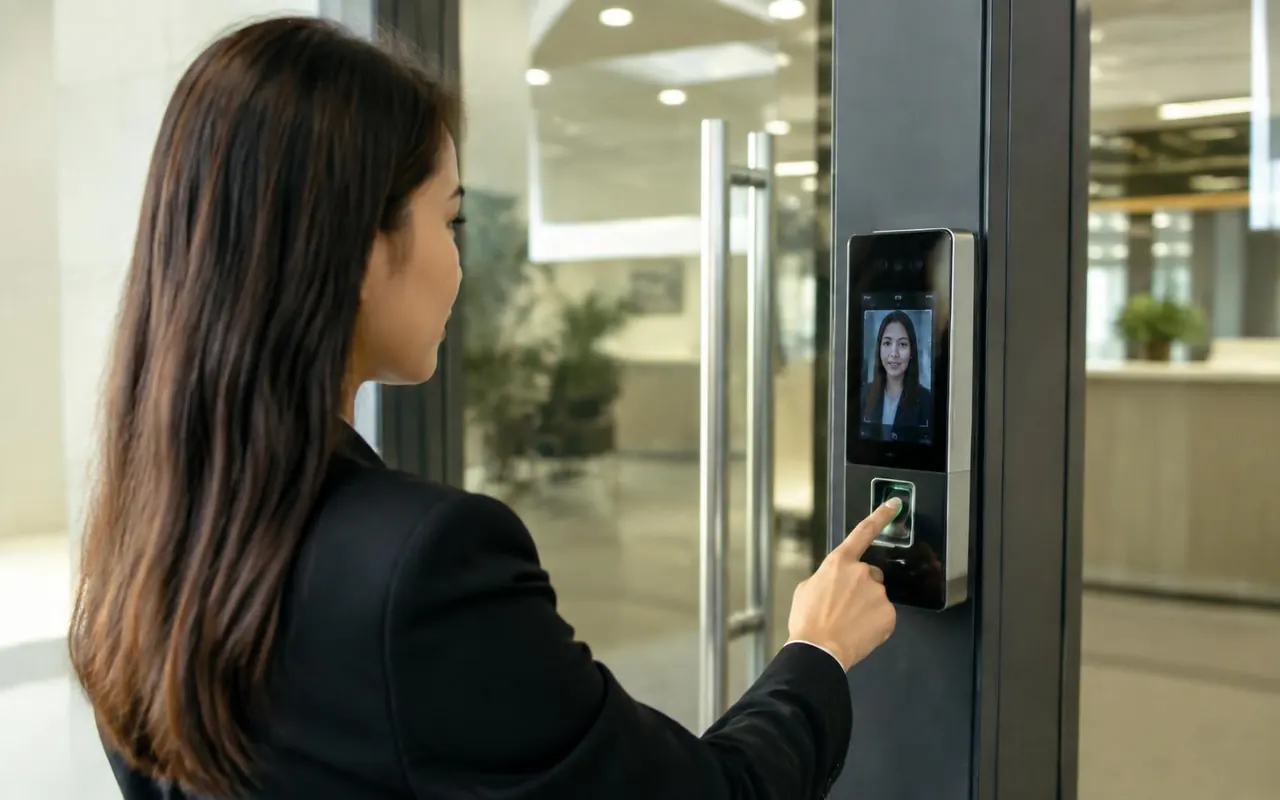
This page is part of our entrance automation solutions range. Keys get copied, lent and lost, and nobody knows who opened the lab at 2 am. Access control systems in Hyderabad replace that guesswork with a log of every entry and the power to block a lost card in seconds. We plan each door around its users, its traffic and its role in a fire. Single doors are covered on our door access control page.
How the parts fit together
At each door, someone presents a credential to a reader. A controller checks it against the user list and, if allowed, releases the lock for a few seconds. People leave by pressing an exit button, and a door contact reports if the door is propped open.
Power comes from a supply unit with a battery, so the door keeps working in short power cuts. Software holds the users, door groups, schedules and reports. Small offices can run standalone units, while campuses use networked controllers with one central database.
- Reader for card, PIN, fingerprint or face
- Controller, single-door or multi-door
- Lock suited to the door type
- Exit button and green break glass
- Door position contact
- Power supply with battery
- Management software
Cards, phones, fingers or faces
Each credential suits a different kind of door and user. Many Hyderabad offices use cards at the main entrance and face readers at server rooms or labs.
| Credential | Good points | Watch out for | Typical door |
|---|---|---|---|
| Proximity or smart card | Cheap, fast, easy to cancel | Cards can be shared | Office entrances, floors |
| Mobile credential | Issued remotely, nothing to carry | Phone battery and app needed | Co-working and modern offices |
| Fingerprint | Cannot be lent | Struggles with worn or wet fingers | Small offices, stores |
| Face recognition | Touch-free and quick | Needs even lighting | Labs, data rooms, hospitals |
Matching the lock to the door
Glass and aluminium doors usually take a magnetic lock fixed to the frame. Wooden and steel doors with a mortise lock often suit an electric strike. Frameless glass doors use a drop bolt into the floor or header.
We check frames, hinges and door closers during the survey. A heavy door with a weak closer will not shut fully, and the lock cannot hold it. Those faults get fixed first.
Doors that open in a fire
Any controlled door on an escape route must open when the fire alarm goes off. We wire a fire alarm relay into the lock power, so the alarm cuts power and the door releases. Fail-safe locks open when power is lost, which is the safe default for exit doors.
A green break glass beside each door gives a manual way out if electronics fail. The release is tested at handover with the fire alarm team. Our fire and CCTV integration service ties these releases into the wider alarm plan.
Attendance, visitors and audit trails
Readers at the main entry can double as attendance terminals, exporting in and out times for payroll. Where you only need attendance, a standalone biometric attendance system costs less.
Visitors can get day passes or codes that expire automatically. Adding a video door phone lets reception see who is outside before letting them in. Audit trails show every door opening, which helps after a theft or a dispute.
Turnstiles, boom barriers and gates
At busy entrances, turnstiles let one person through per credential and stop tailgating. At vehicle gates, boom barriers open for cards, remotes or number plate cameras. Motorised sliding gates can join the same system.
When gates and doors share one software, a single card or face works everywhere a person may go. Reports then cover the whole site in one place.
Keeping the system secure
An access system holds the keys to your building, so it needs basic security. Change default passwords on controllers and software, and give each administrator their own login. Remove leavers on their last day, not at the end of the month.
Older proximity cards can be copied with cheap tools. For server rooms and labs, choose encrypted smart cards, mobile credentials or face readers. Keep controllers on a separate network from guest Wi-Fi, and back up the user database regularly.
We review these points at handover and on service visits, and we give you a short checklist for the admin team.
Choosing standalone or networked
A standalone reader stores its own users and works without a server. It suits a single office door or a store room, and setup is quick. Each door must be updated one by one, though, which becomes slow past a few doors.
A networked system links all controllers to one program. Add or block a user once and every door follows. Reports, schedules and alarms come from one screen, so most offices with more than a handful of doors choose this route.
Planning for growth
Offices change floors, add tenants and open new wings. A networked system grows by adding controllers, while standalone units have to be set up one by one. If you expect growth, start with a controller and software that can take more doors.
Keep a door schedule listing every reader, lock and controller. It makes later changes quicker and helps any engineer understand the system.
Access control across Hyderabad
Corporate offices in Hitech City, Gachibowli and Nanakramguda use card access on floors and face readers at server rooms, labs and data rooms. Many also link readers to CCTV so every entry has a picture.
Hospitals in Banjara Hills and Secunderabad control pharmacy stores, records rooms and staff areas. Gated communities in Kokapet and Kondapur combine boom barriers, turnstiles at clubhouses and video door phones at towers.
Our Gachibowli team designs and installs access control systems in Hyderabad, and the Hyderabad office page lists our other services. For coastal sites, see access control systems in Visakhapatnam.
Areas we serve. Not sure we cover your area? Call the office and ask.
- Hitech City
- Gachibowli
- Nanakramguda
- Banjara Hills
- Secunderabad
- Kokapet
- Kondapur
Standards and approvals
Locks on escape routes must fail safe in a fire and follow the exit provisions of NBC 2016 Part 4. Controlled doors must not block exits that the Telangana State Disaster Response & Fire Services Department expects to stay usable. We share wiring and release details when an inspector asks.
How the work runs
- SurveyWe check each door, gate and lane, with frames, widths, power and network points.
- Design and quoteYou get a door schedule with readers, locks and controllers, plus an itemised quote.
- InstallationCabling, locks, readers and controllers go in, with fire release on escape doors.
- SetupWe enrol users, set schedules and test every door, including fire release.
- HandoverAdmin training and the door schedule complete your access control systems in Hyderabad.
What affects the price
- Number of doors, lanes or gates
- Type of lock or barrier
- Credential type: card, face or fingerprint
- Controller and software
- Civil and electrical work
- Gate or road width
- Integration with fire alarm and CCTV
What to send us
- Door or gate photos with width and height
- Site plan
- Number of users
- Details of any current system
- Power and network points available
- Your deadline