

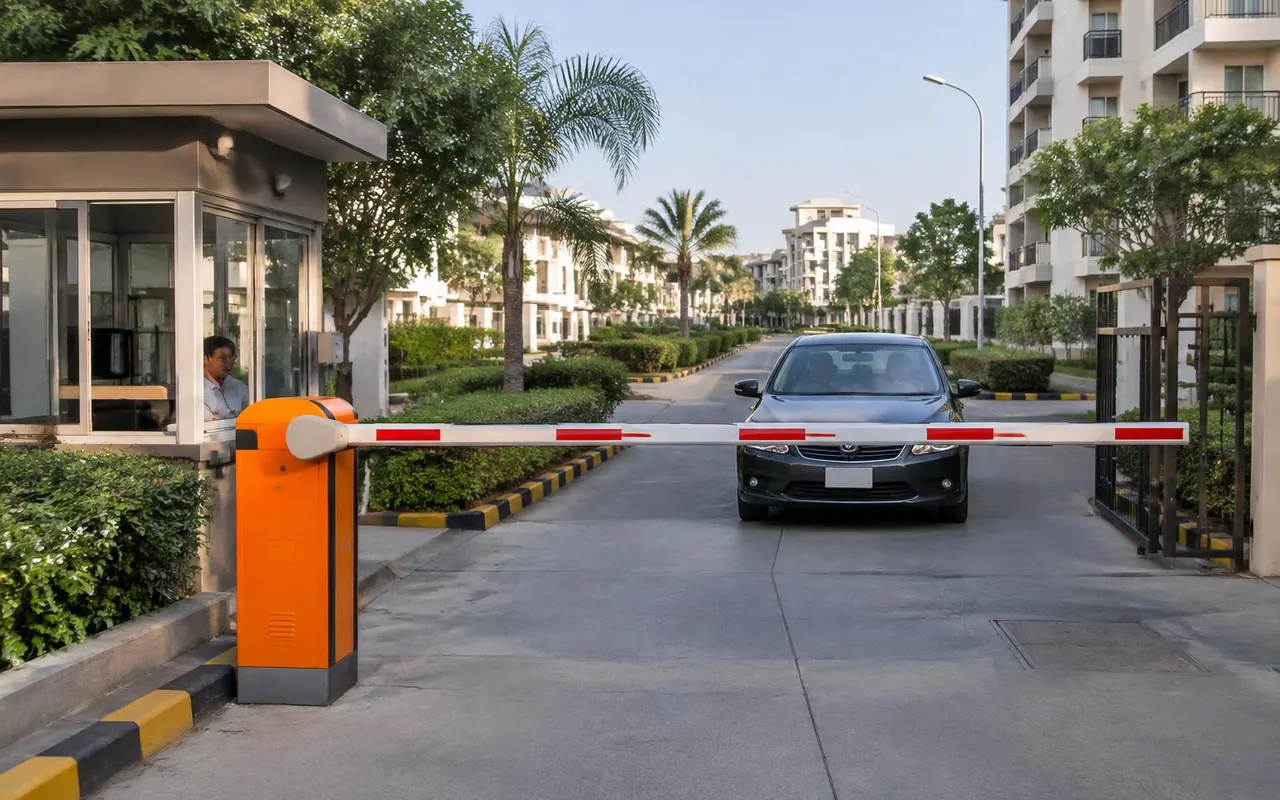
Sites often buy the cheapest option and then find it does the wrong job. The choice of boom barrier vs bollard vs tyre killer depends on what you need to stop, how often and at what risk. This guide explains each one and where it fits.
The boom barrier
A boom barrier lifts an arm to let vehicles pass and lowers it to stop them. It is quick, cheap and suits car parks, gates and toll points. The arm manages flow and checks who enters. Even so, a vehicle that wants to force its way through will not be stopped.
Read our boom barrier page for models and speeds.
The bollard
Bollards are posts, fixed or automatic. Fixed ones keep vehicles out of pedestrian areas. Automatic ones rise and sink on demand for deliveries and emergency access. Crash-rated models are tested to resist a vehicle impact.
Ordinary bollards are not crash-rated, so ask for proof of the rating. See our page on automatic bollards.
The tyre killer
A tyre killer is a set of spikes that rise to puncture tyres of vehicles driving over it in the wrong direction. It is used for exit lanes, where entry must be prevented. It can stop a vehicle in its tracks, but it can also harm tyres, so signs and rules are vital.
Learn more on the tyre killer page.
Matching device to risk
Use a boom barrier where you want to control and record access. Add bollards where a vehicle could be used as a weapon or where pedestrians need protection. Use a tyre killer in one-way exits where wrong-way entry is a risk.
High-risk sites often combine all three with cameras and guards.
Safety and law
Every device must be safe for people. Barriers need sensors and a manual release. Bollards and tyre killers need warning signs, lights and a plan for emergency vehicles. Check local rules and the site's own security policy before choosing.
Mistakes to avoid
When buyers compare boom barrier vs bollard vs tyre killer, they often fall into these traps.
- Buying a boom barrier and expecting it to stop a forced entry
- Accepting bollards without a stated crash rating
- Installing a tyre killer without signs and a safe procedure
- Forgetting foundations and utilities under the lane
- Ignoring emergency vehicle access
Your next step
Send us photos of the lanes and tell us the risk you face. We will suggest the right device, or a mix, and quote it with the civil work shown. Essatech designs, supplies, installs and services these systems in Hyderabad and Visakhapatnam. Send us your drawings or photos for a priced plan.
What affects the price
- Number of lanes
- Device type and duty cycle
- Crash rating, if required
- Foundations and civil work
- Sensors, lights and signs
- Controls and cameras
What to send us
- Photos and width of each lane
- Vehicle types and numbers
- Risk you want to cover
- Existing gates and cameras