

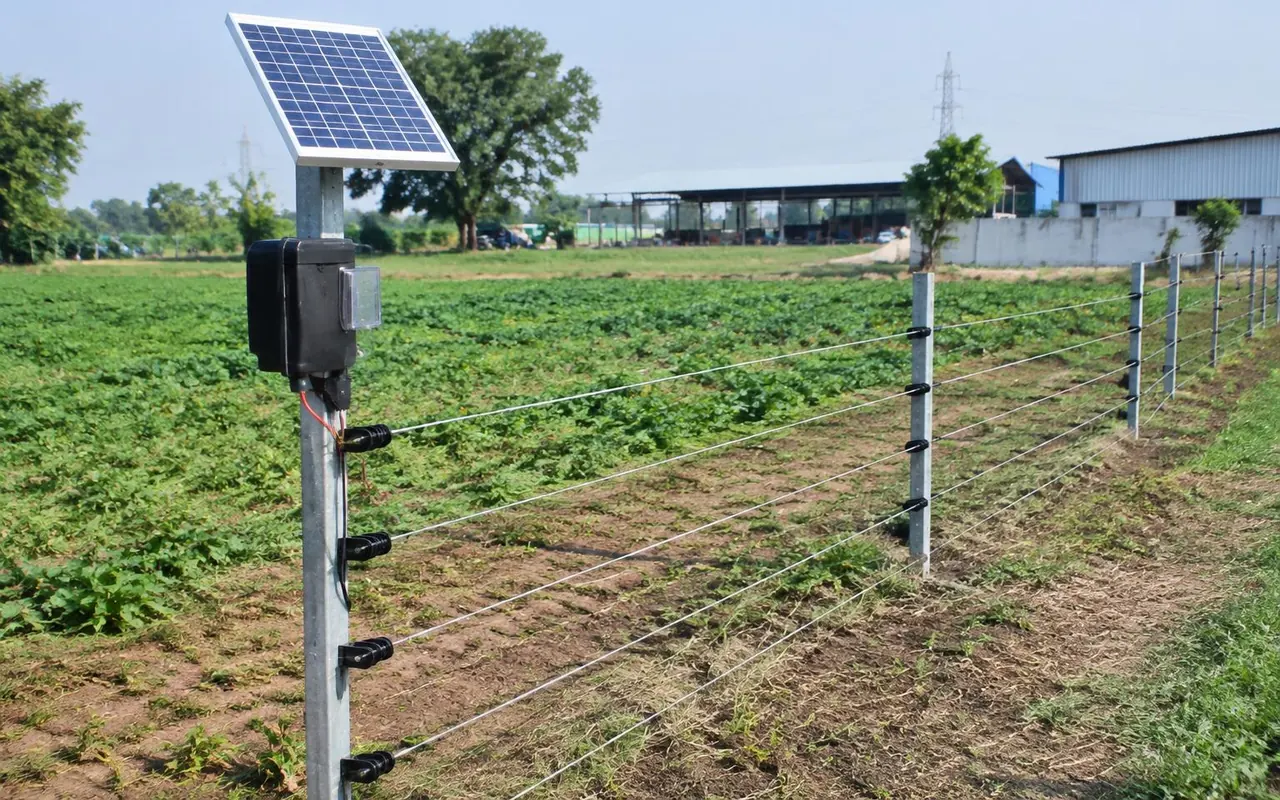
What solar fencing does
Solar fencing, also called solar electric fencing, forms a first line of security around your premises. Multiple wire strands create a barrier that discourages climbing or passing through the fence. You can use it alongside CCTV surveillance and a burglar alarm system to support security within the premises. It deters a person before they reach a wall or a gate, which no camera can do on its own.
How solar electric fencing works
An energizer sends electrical pulses through the fence, and double-insulated (DI) cable connects the fence to the energizer. The system described here produces a peak voltage of about 9,000 to 10,000 volts, with 45 pulses every 60 seconds. Pulse energy is measured in joules. Solar photovoltaic panels generate electricity and charge a maintenance-free battery, and the battery supplies 12-volt power to the energizer. An optional automatic charging module can charge the battery from mains electricity when the battery voltage is low. A hooter sounds when the system detects an intrusion or a short circuit in the fence, and a GPRS module can connect to the energizer to send an SMS alert when the fence is shorted.
Fence construction and components
Positive and negative high-tensile (HT) wires run around the perimeter, either on a compound wall or in a ground-level fence. The height and number of strands depend on the site and the fencing layout. A typical intermediate pole is 1 metre high, with a 1-foot foundation inside the wall, and poles are made of hot-dip galvanised mild steel. These dimensions can vary to suit the premises. For domestic use, fence heights can range from half a foot to 1 metre, with 6 to 9 strands. The main components are:
- Anti-climb insulators keep wires from touching the poles and becoming earthed
- Support poles brace corner poles against wire tension
- Wire tighteners keep the fence wires taut and straight
- Earthing kits connect to the negative strands at intervals of 200 metres to support conductivity
- The energizer, solar panels, battery and double-insulated cable form the power system
Where solar fencing is used
Industrial solar fencing helps restrict unauthorised entry and the unauthorised removal of materials, including scrap stored within industrial premises that could otherwise be stolen. Agricultural fencing helps protect crops by restricting animal entry into farms, especially near forests. Typical sites are:
- Industries and warehouses
- Commercial areas and building sites
- Apartments and gated communities
- Farms and forest boundaries
- Homes and large plots
For builders, architects, MEP consultants, corporates, industries, hospitals and defence
Builders use solar fencing to protect open plots and sites under construction, where materials are often stolen. Architects can show the fence on the boundary drawing, and we advise on wall height, pole positions and the gate openings. Industries protect scrap yards, stores and open stock, and commercial building owners add a deterrent to the wall. Hospital owners with large campuses use it on quiet back boundaries, where people should be kept out, with warning signs along the fence and no risk to patients or visitors. MEP consultants can include fence zones and energizers in the site drawings. Corporates protect campuses and plots. Defence establishments, including Navy and Army boundaries and depots, use perimeter fencing alongside cameras, and we plan and quote within their security and vendor rules.
Safety and signs
An electric fence must be safe. Energizers are made so the pulses are brief and low in energy, and the fence carries warning signs at regular intervals. We keep it clear of areas where the public can touch it, and we set up the alarm so any short circuit or cut wire is reported. We explain the safety rules to your security team at handover.
What you get from Essatech
Essatech supplies, installs and services solar fencing in Hyderabad and Visakhapatnam. The job covers:
- A free site visit to measure the boundary and check walls and gates
- A layout with the height, strands, poles and earthing
- Supply and installation of the energizer, solar panels, battery and fence
- Hooter and SMS alerts set up, with a test of every zone
- Warning signs and a safety briefing
- Service visits that include cleaning panels, tightening wires and clearing vegetation
What decides the cost
A quote for solar fencing depends on:
- The boundary length and the number of strands
- Wall-mounted or ground-level construction
- The energizer size, solar panels and battery
- Alerts such as a hooter or SMS, and the number of gates
What to send us for a quote
Share these through the quote page or on WhatsApp:
- The boundary length, with a sketch or satellite image
- Whether there is a wall, and its height
- The number of gates and openings
- Your location and the date you need the work done
Talk to our local team
Share your location, type of building and what you need. We will suggest the right equipment and explain installation and maintenance.