

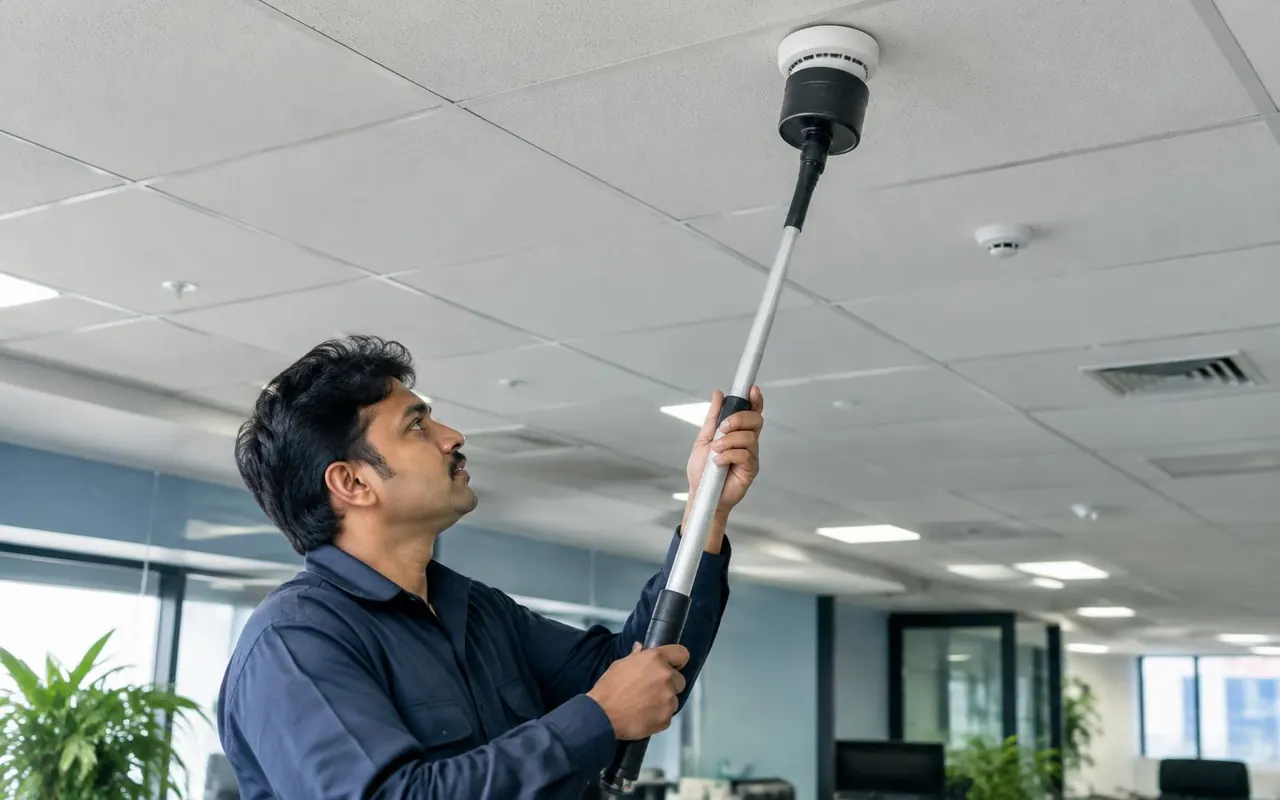
Why test smoke alarms regularly?
An early warning of smoke gives you more time to leave safely. Regular testing helps you find power or alarm faults before an emergency. Smoke alarms and smoke detectors use sensors to detect smoke particles, and dust and contamination can affect these sensors over time, so testing and maintenance both matter. Include alarm testing in your maintenance routine and follow local fire safety regulations and building codes. Testing serves three purposes:
- Check that the alarm can sound a warning
- Identify battery or power problems
- Keep cleaning and maintenance on schedule
How to use the smoke alarm test button
Most smoke alarms have a test button. Follow the manufacturer's instructions, which usually involve pressing and holding the button for a few seconds until the alarm sounds. The sound confirms that the alarm's test function works, but it does not by itself confirm that the sensor can detect smoke. If the alarm stays silent, there may be a battery or alarm fault. For a smoke-response test, use smoke detector test spray only as directed by the alarm manufacturer. If the alarm does not respond, it may need cleaning or replacement.
Check batteries and keep the alarm clean
For alarms with replaceable batteries, follow the manufacturer's replacement schedule. These batteries commonly need replacement at least once a year. Some alarms have a low-battery indicator, but do not rely on that warning alone. Dust and debris can collect inside an alarm and affect its performance, so follow the manufacturer's cleaning instructions, which may allow a vacuum cleaner or compressed air to remove particles.
Smoke alarm testing in commercial buildings
A single home alarm is tested by pressing a button. A commercial fire alarm system with many detectors is different: each detector must be tested with approved smoke test equipment, and the alarm must be seen on the fire alarm panel. In factories, hospitals, towers and malls this is done by a trained technician, who also checks the panel, batteries, hooters and call points and writes the results in a logbook. A building that cannot show test records is hard to defend to an inspector or an insurer.
For builders, architects, MEP consultants, corporates, industries, hospitals and defence
Builders and architects should plan test access: detectors that cannot be reached with a pole or a ladder will not be tested. Industries should schedule testing around production, so no area is skipped. Hospital owners should test in a planned sequence, ward by ward, with the nursing staff informed, so alarms are checked without disturbing patients. In every case, the test schedule should be written down and followed. MEP consultants can include a testing schedule in the maintenance specification. Corporates can set one test routine across offices and campuses. Defence establishments, including Navy and Army sites, can ask for testing under their security and vendor rules.
Make smoke alarm testing part of your routine
Keep smoke alarm testing, battery checks and cleaning in your regular maintenance routine. Deal with faults rather than leaving an alarm that does not respond. A yearly full test with spot checks in between is common under a maintenance contract, and each test goes in a logbook with the date, the detector location and the result.
What Essatech does
For smoke alarm supply, installation and maintenance in Hyderabad and Visakhapatnam, contact Essatech. We offer:
- A free site visit and a review of your alarm and test records
- Testing of every detector, call point and hooter, with a written report
- Cleaning, repair and replacement of failed detectors
- A maintenance plan, such as our fire safety AMC in Hyderabad
- Training for your staff on basic checks
What to send us for a quote
Share these through the quote page or on WhatsApp:
- The type of building and the number of floors
- The number of detectors, or the make of your system, if you know it
- The date of the last test, and any records you hold
- Your location and the date you need the testing done